
My Cart
You have no items in your shopping cart.
However, for those new to the field—or even seasoned professionals—navigating the technical jargon can be daunting. Understanding these terms is essential when ordering custom mirror glass or architectural panels for your home to ensure you make informed decisions and communicate effectively with installers. This glossary of common tempered glass terms is designed to demystify the language of glass, offering clear and concise definitions to help you build confidence.
This glossary of common tempered glass terms is designed to demystify the language of glass, starting with a fundamental definition of tempered glass and offering clear, concise definitions to help readers build confidence in their knowledge of this essential material.
Table of Contents
Also known as toughened glass, understanding what is tempered glass is a type of safety glass processed by controlled thermal or chemical treatments to increase its strength compared to normal glass. When broken, it shatters into small, blunt pieces instead of sharp shards.
Request a QuoteStandard glass that has not been tempered. It is more prone to breaking into sharp, jagged pieces and is less durable than tempered glass.
A process where glass is heated and cooled to increase its strength (about twice as strong as annealed glass) but not to the level of fully tempered glass. Unlike tempered glass, it does not shatter into small pieces when broken.
A type of safety glass made by bonding two or more layers of glass with an interlayer (usually PVB or EVA). Even when broken, the interlayer holds the glass together, reducing injury risks. Often used alongside tempered glass for added safety.
A rare occurrence where tempered glass breaking without any direct impact, usually due to nickel sulfide (NiS) inclusions or internal stresses.
A tiny impurity that can cause tempered glass to break unexpectedly due to expansion over time. Heat soaking tests help reduce this risk.
A quality control process where tempered glass is heated to identify potential NiS inclusions that could cause spontaneous breakage.
The finishing process on the edges of tempered glass (e.g., seamed, polished, or beveled edges) to enhance durability and aesthetics.
The outer layer of tempered glass is under high compression, making it stronger than untreated glass. This is achieved through rapid cooling during the tempering process.
Regulations and testing methods (e.g., EN 12150, ANSI Z97.1) that define the strength and breakage patterns required for tempered glass to be considered safe.
A test to ensure tempered glass breaks into small, harmless pieces as per safety standards. Unlike standard glass, the shatter pattern of safety glass is strictly defined by the number of fragments per square inch to ensure it poses no threat upon breaking.
A specialized furnace used to heat glass uniformly before rapid cooling (quenching) to create tempered glass.
The rapid cooling process in tempering that creates surface compression, giving tempered glass its strength.
The ability of tempered glass to withstand high wind pressures without breaking, important for architectural applications.
Tempered glass’s ability to resist physical blows,one of the many advantages and disadvantages of tempered glass making it suitable for doors, shower enclosures, and vehicle windows.
Request a QuoteThe base glass used before tempering, made by floating molten glass on molten tin to create a smooth, even surface.
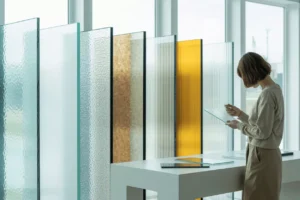
Tempered glass with added color (e.g., bronze, gray, or blue) for aesthetic or solar control purposes.
Tempered glass with an etched or sandblasted surface for privacy or decorative effects — but how does it compare in durability to scratch resistant tempered glass?
Tempered glass bent into a curved shape during the heating process, used in automotive and architectural designs.
Slight distortions or waves in tempered glass caused by rollers during the heating process, usually minimal but noticeable in reflections.
Whether you’re a homeowner exploring renovation options, an architect specifying materials, or simply curious about the science behind safety glass, having a solid grasp of tempered glass terminology is invaluable. This glossary serves as a handy reference, equipping you with the language needed to navigate conversations, documentation, and technical specifications with ease. As the industry evolves, staying familiar with these terms ensures you remain informed. Whether you need tempered glass cut to size for a home DIY or a large-scale architectural project, knowing the language helps ensure a perfect result.

Explore all things glass—from stylish table tops and insulated options to tinted and frosted designs. Discover guides on glass railings, custom cut glass, shelves, and stunning backsplash ideas for a modern home or office upgrade.