
My Cart
You have no items in your shopping cart.

The design and operation of US healthcare facilities, from sprawling hospitals to specialized local clinics, are governed by an intricate web of regulations designed to protect patient health, privacy, and safety. For facility managers, architects, and interior designers, selecting materials that seamlessly meet these stringent codes while contributing positively to the healing environment is a constant challenge. Many industry professionals now rely on trusted suppliers like Fab Glass and Mirror, known for delivering high-quality glass solutions that align with strict healthcare compliance standards.
This article establishes the indisputable case for using frosted glass for partition systems as the optimal, future-proof solution. By balancing natural light transmission, unparalleled hygiene standards, and critical regulatory compliance, frosted glass wall partitions are transforming modern medical interiors, enhancing patient experience, and improving staff efficiency.
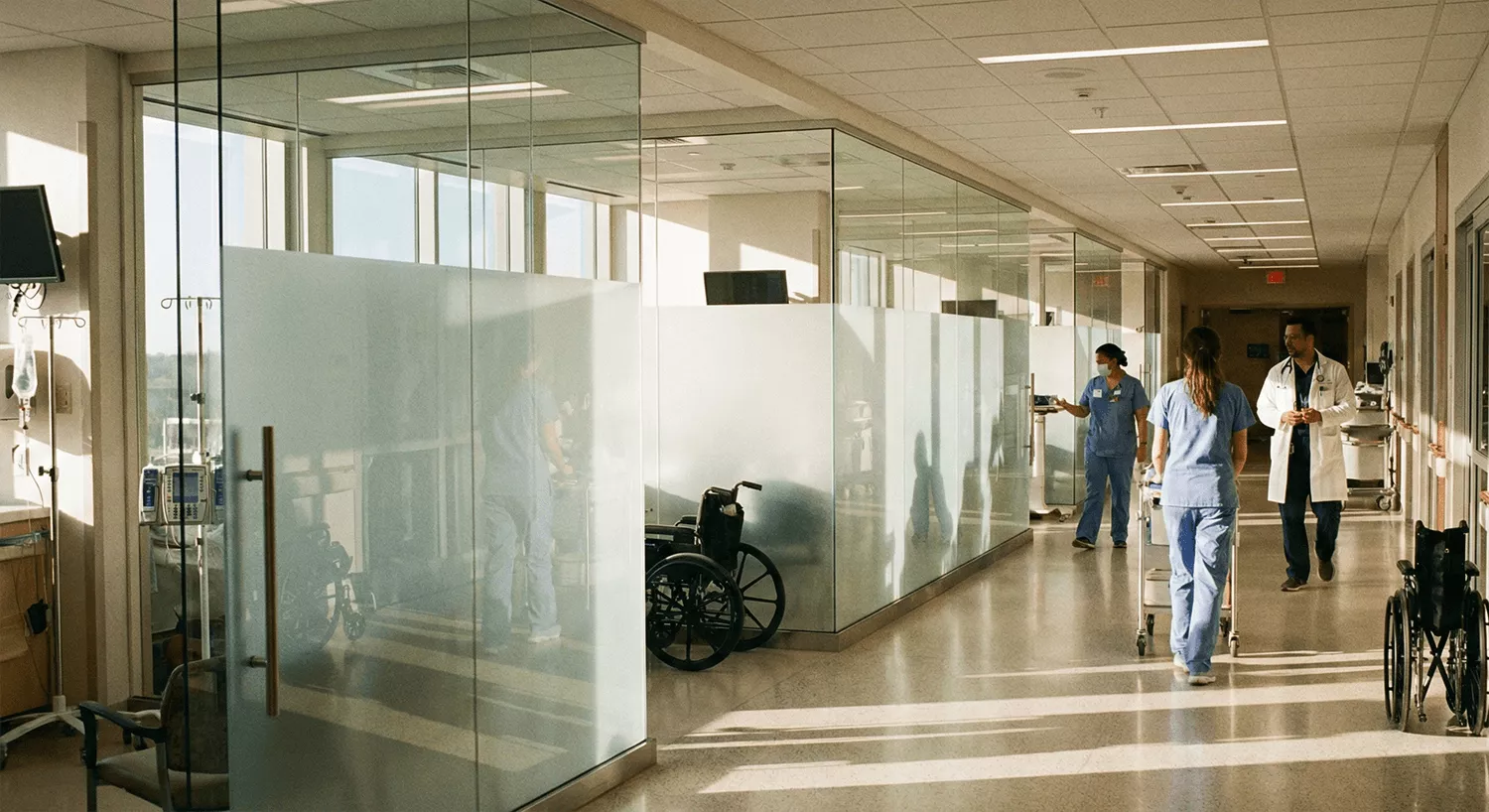
Table of Contents
The challenge in contemporary healthcare design lies in balancing competing needs: the patient’s right to absolute privacy, the need for stringent infection control, and the psychological benefits of maximizing natural light. Traditional solutions often force compromises. Clear glass offers light, but sacrifices privacy. Drywall ensures privacy but creates dark, confining spaces and harbors pathogens.Frosted glass offers the optimal, future-proof solution. They are engineered to meet stringent US healthcare codes, from ADA accessibility to NFPA fire safety, while dramatically enhancing the patient experience and staff performance. This material represents a significant upgrade, providing a durable, hygienic, and aesthetically pleasing alternative to outdated materials. We will delve into how these systems achieve regulatory compliance, maximize hygiene, and support efficient, healing environments.
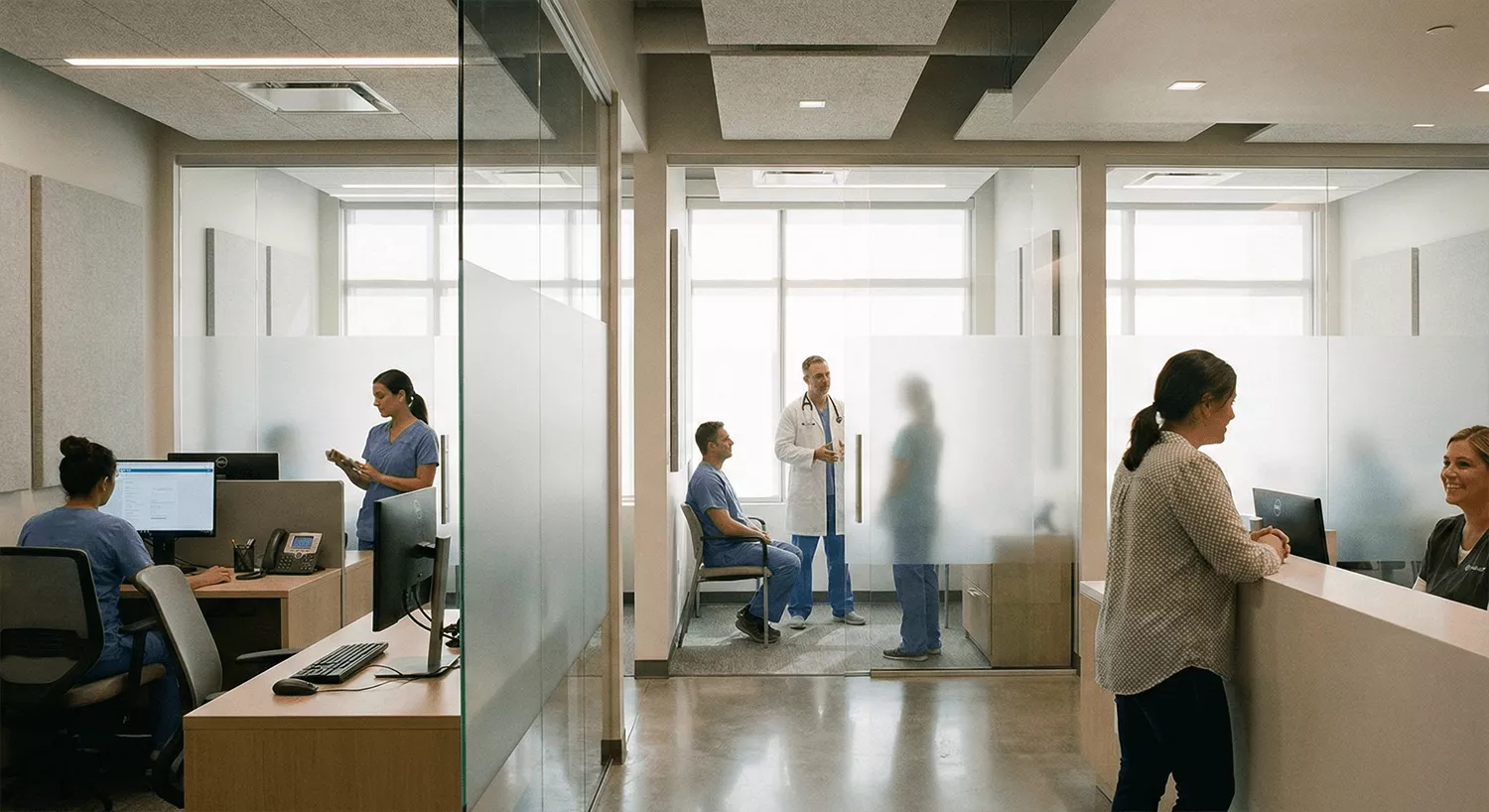
In the United States, the Health Insurance Portability and Accountability Act (HIPAA) is the bedrock of patient confidentiality. While often associated with digital data, HIPAA extends its reach to the physical environment, requiring healthcare providers to implement “appropriate administrative, technical, and physical safeguards” to protect Protected Health Information (PHI). This includes visual and auditory privacy. Using frosted glass for hospital room partition walls and consultation areas is key to achieving physical compliance.
Standard clear glass fails the visual privacy test, particularly in sensitive areas like examination rooms, recovery bays, and consultation offices. A subtle visual breach is a HIPAA violation waiting to happen.
Frosted glass panels address this head-on. Whether achieved through acid-etching, sandblasting, or high-performance vinyl film, the frosting process diffuses light and obscures detailed visual information, preventing unauthorized observation of the patient or their records. This type of privacy glass allows soft, diffused light to penetrate the space, a significant psychological benefit, while rendering figures and objects within the room as non-descript shapes, thus eliminating visual breaches.
The difference between true frosted glass and basic window film is critical for longevity in a healthcare setting. High-quality acid-etched glass offers a permanent, durable finish that is less susceptible to peeling or bubbling, which can be a maintenance issue with lower-grade applied films.
Title II of HIPAA (the Privacy Rule) requires that facilities minimize the chance of incidental disclosures of PHI. This is especially true in fast-paced clinical settings where conversations often occur near waiting areas. Using frosted glass for clinics partition systems in reception areas, patient intake desks, and administrative offices prevents “peeping” at schedules, intake forms, or computer screens that may contain PHI.
While privacy glass handles the visual aspect, HIPAA compliance is incomplete without addressing sound. The material itself is not enough; the complete system is what matters. Implementing double-glazed frosted glass wall partitions or laminated glass with an increased Sound Transmission Class (STC) rating is vital. A minimum STC rating of 35–40 is generally recommended for privacy walls in clinical settings to ensure that conversations in examination rooms are not intelligible outside the space, completing the total HIPAA physical safeguard solution (visual + auditory).
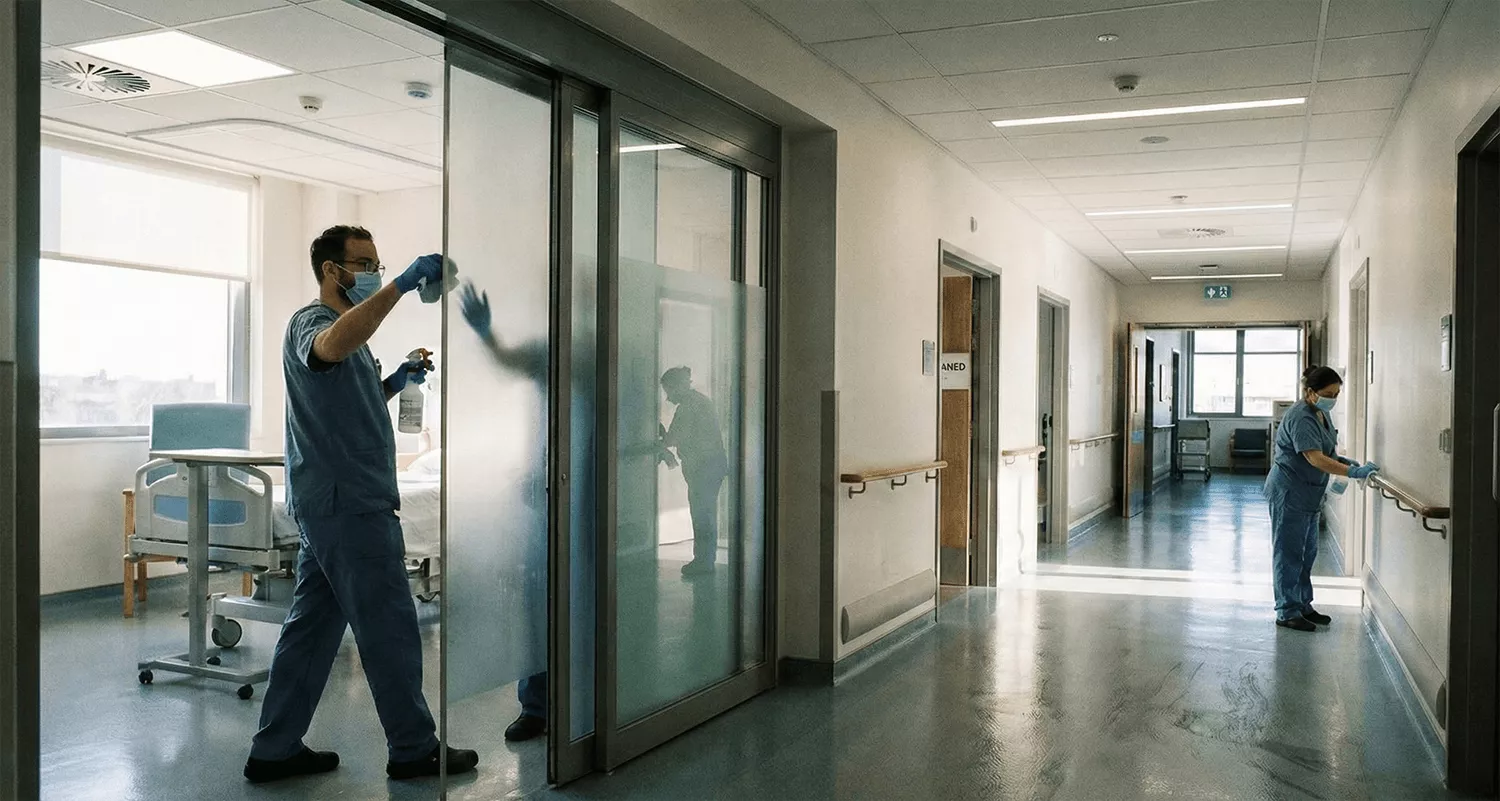
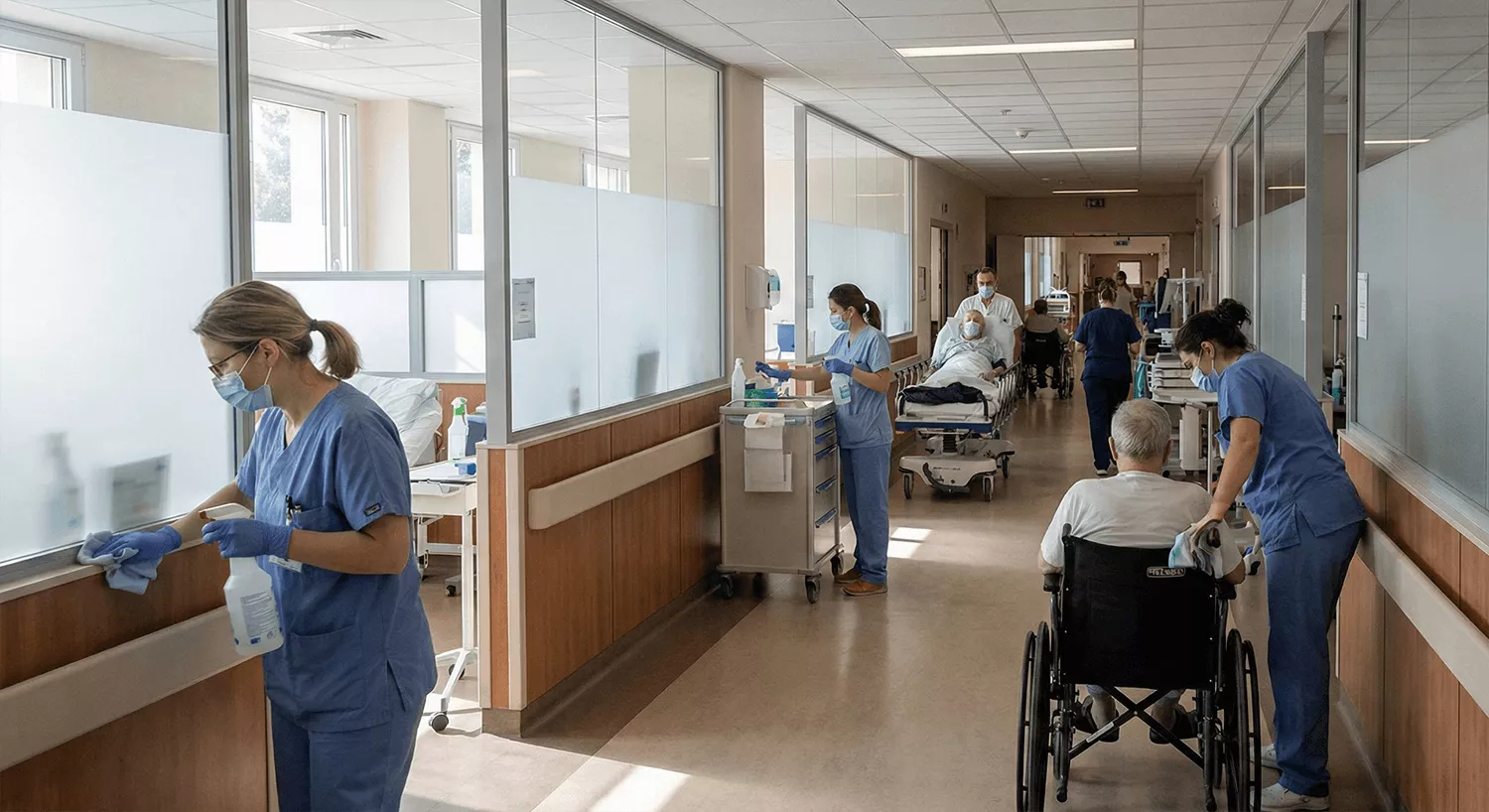
Hospital-Acquired Infections (HAIs) are a significant threat to patient safety and a major financial burden for facilities. Every material choice must be scrutinized through the lens of infection control. Frosted glass for partition systems presents a compelling advantage over traditional materials.
Unlike porous materials like fabric curtains, standard drywall, or wood-based millwork, glass is inherently non-porous. This means pathogens, bacteria, and viruses cannot seep into the material.
Facility managers require materials that can withstand rigorous, daily cleaning with harsh, hospital-grade disinfectants (bleach solutions, quaternary ammonium compounds, etc.). High-quality frost glass surfaces are chemically inert and will not degrade, pit, or discolor under repeated exposure to these strong agents, ensuring the surface remains smooth and sanitized for the life of the partition.
| Feature | Frosted Glass Partition | Standard Drywall | Fabric Curtains/Blinds |
| Porous/Non-Porous | Non-Porous (Impervious) | Porous (Absorbs moisture) | Highly Porous (Harbors pathogens) |
| Infection Risk | Very Low (Can include antimicrobial coatings) | High (Supports mold/bacteria growth) | Very High (Contributes to HAIs) |
| Chemical Resistance | Excellent (Withstands hospital-grade disinfectants) | Poor (Discolors, softens under strong chemicals) | Very Poor (Requires special laundering) |
| Life Cycle Cost | Low (High initial, very low maintenance/long life) | High (Low initial, high maintenance/replacement) | Medium (Regular laundering/replacement) |
| Daylight Transmission | Excellent (Diffused, glare-free) | None | Blocks light (Requires opening for light) |
The next generation of frosted glass panels incorporates integrated antimicrobial coatings. These invisible layers often utilize silver ions or titanium dioxide, which are proven to inhibit the growth of bacteria, fungi, and mold upon contact.
This proactive antimicrobial layer provides continuous, 24/7 protection, making the glass a hostile environment for pathogens even between routine cleanings. Specifying this feature, a true differentiator, establishes a superior level of commitment to preventing HAIs compared to standard wall materials.
The durability of glass systems translates directly into reduced long-term operating costs.
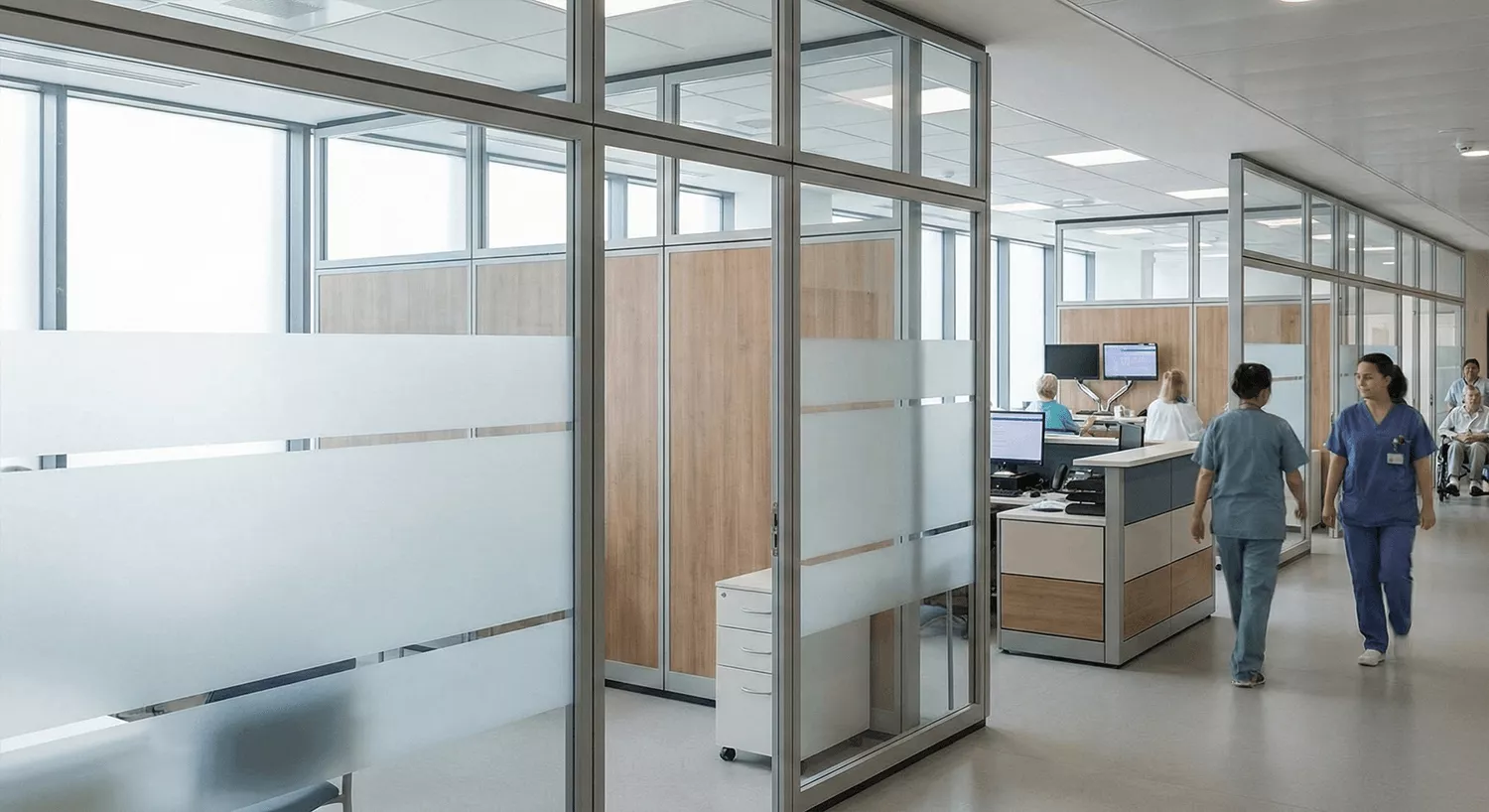
A well-designed healthcare environment is an investment in human capital. Frosted glass contributes to creating spaces that are less stressful for staff and more conducive to healing for patients.
Access to natural light, or daylighting, is directly linked to positive health outcomes, reduced patient pain, shorter hospital stays, and enhanced staff performance, including lower error rates and improved mood.
Clear glazing can cause debilitating glare. Frosted glass is the ideal intermediary. It delivers deep light penetration into interior spaces (such as internal hallways and staff offices) without creating harsh shadows or blinding glare. This is particularly effective when applied to exterior frosted glass windows, where it manages brightness while preserving privacy for occupants inside.
In environments like nurse stations, pediatric units, or recovery areas, immediate visual awareness of patients is critical. Frosted glass for hospital room partition walls can be strategically designed using “partial frosting.”
This design often involves a transparent stripe at eye level, a clear band near the floor for observation, or frosting applied only to the central band of the glass, preserving a clear sightline over the top. This allows clinicians to maintain essential visual communication and supervision while respecting the patient’s right to feel enveloped in privacy frosted glass for windows and walls. The use of a frosted glass interior door with a vision panel offers a similar balance for individual rooms.
Healthcare needs are constantly evolving. A new infectious disease wing, expanded surgical capacity, or a shift from acute care to outpatient services often necessitates rapid facility reconfiguration. Demountable frosted glass wall partitions are a strategic asset, allowing facilities to quickly and cost-effectively reconfigure layouts, from expanding waiting rooms to creating new private consultation spaces, without the dust, noise, and downtime associated with traditional drywall construction.
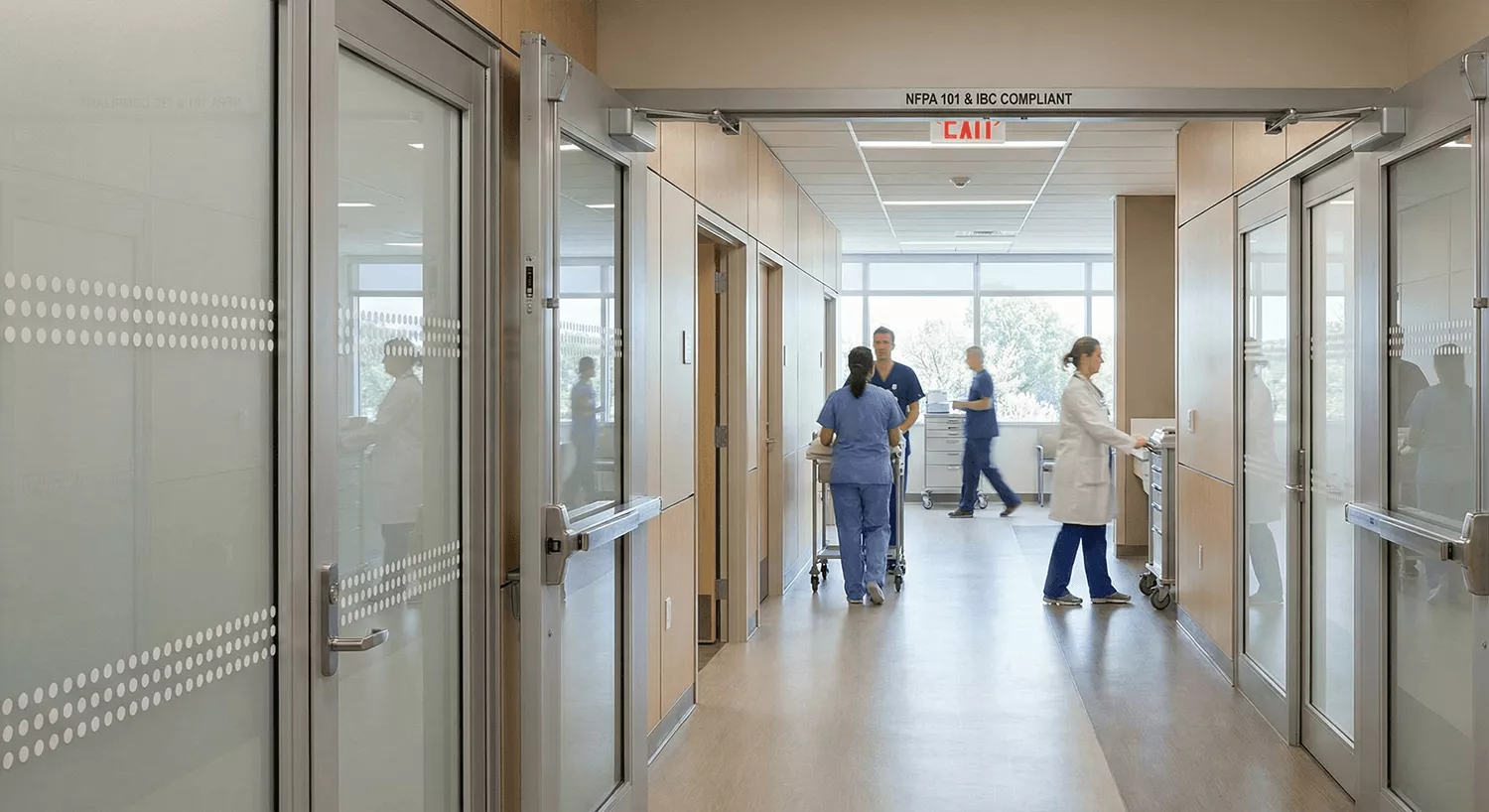
For any material to be successfully integrated into a US healthcare facility, it must meet several overlapping federal, state, and local building codes.
Fire safety is non-negotiable. Glass used in healthcare corridors, room separations, and adjacent to exit routes must comply with the International Building Code (IBC) and the National Fire Protection Association’s Life Safety Code (NFPA 101).
Standard frosted glass panels are not fire-rated. Specialized, multi-layered fire-rated glass systems must be specified for use in required fire-rated walls (typically 1-hour or 2-hour separation). Your solution must address the requirement for both integrity (withstanding fire) and temperature rise (limiting heat transfer).
Every frosted glass door used in a fire-rated corridor must be part of an approved assembly, including fire-rated frames and self-closing, positive-latching hardware to ensure safe egress and containment.
The Americans with Disabilities Act (ADA) ensures equitable access for all. When using glass, collision risk must be mitigated.
The ADA and local building codes often require “manifestation” on large expanses of clear or frosted glass for partition walls. This typically involves contrast markings (stripes, patterns, or logos) at specific heights (e.g., 34-38 inches and 60 inches above the floor) to make the glass visible to visually impaired individuals. The subtle texture of frost glass can help, but required contrasting graphics must still be applied.
Patient safety dictates that glass in certain areas, known as “hazardous locations”, must not shatter into dangerous shards upon impact.
All glass in doors (including frosted glass interior door), sidelights, and partitions near patient beds, walkways, or wet areas (e.g., showers, labs) must be safety glazed. This means using:
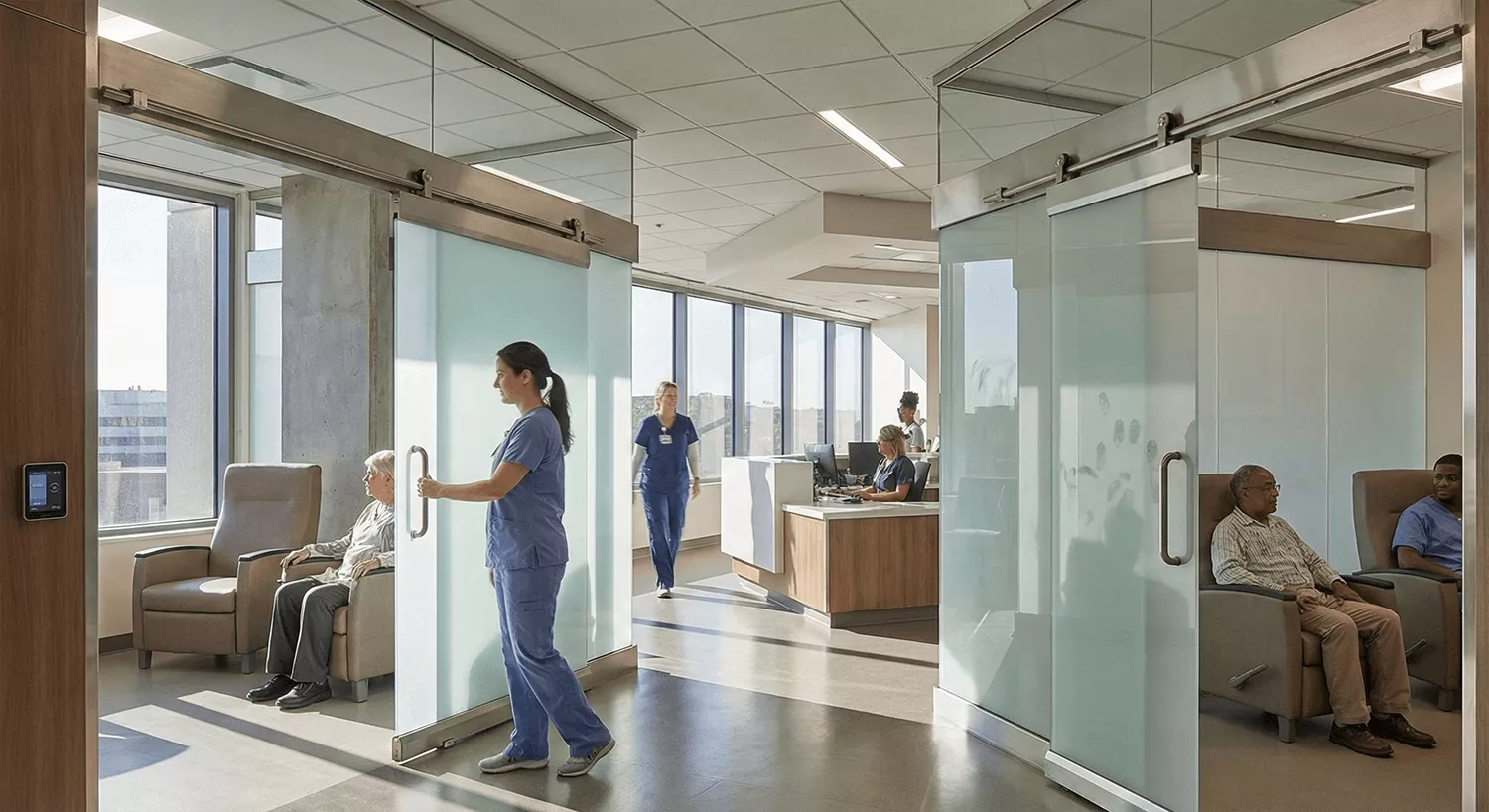
While classic frosted glass is the workhorse of healthcare design, advanced electrochromic and digital technologies offer specialized solutions for highly sensitive or high-tech spaces.
Known as PDLC (Polymer-Dispersed Liquid Crystal) glass, this is the ultimate form of privacy glass. It changes from clear to opaque white (a dense frosted look) instantly via an electrical current.
This technology is invaluable in areas like Intensive Care Units (ICUs), Operating Rooms (ORs), and behavioral health wings where immediate, on-demand privacy and control are critical for procedures or patient observation. It eliminates the need for blinds or curtains, further supporting infection control.
Often electrochromic or thermochromic, this type of glass dynamically manages the amount of light and heat passing through.
For exterior frosted glass windows in outpatient lobbies or infusion centers, dynamic shading can manage solar heat gain (reducing cooling costs) and mitigate glare without physically blocking the view, ensuring patient comfort throughout the day.
Modern manufacturing allows for the integration of custom digital printing directly onto the glass surface or film interlayer.
The selection of frosted glass for partition systems is no longer a matter of simple aesthetics; it is a complex decision encompassing HIPAA mandates, rigorous infection control protocols, and life-safety building codes. The modern healthcare environment demands a material that is compliant, hygienic, and conducive to healing—and glass delivers on all fronts.
By choosing demountable, high-STC, safety-rated, and potentially antimicrobial frosted glass wall partitions, US healthcare facilities can confidently transition to bright, adaptable, and compliant interiors.
We invite facility managers, architects, and designers to consult with our compliance team today. Let us help you navigate the specific requirements of your state and facility type (from acute care hospitals to specialized clinics) to deliver a code-compliant, aesthetically superior, and future-proof glass partition solution. We are the experts who understand the complexities of US healthcare construction and regulation, ensuring your project meets every standard, from the NFPA to the latest ADA guidelines.
Frosted glass partitions ensure visual privacy by obscuring detailed forms and preventing unauthorized viewing of PHI (Protected Health Information) in sensitive areas like examination and consultation rooms, while still allowing light transmission.
Yes. Glass is inherently non-porous and chemically inert, meaning pathogens cannot seep into the material. It can withstand daily cleaning with harsh, hospital-grade disinfectants without degrading, which is essential for preventing Hospital-Acquired Infections (HAIs).
All glass in hazardous locations (doors, sidelights, partitions near patient beds) must be Mandatory Safety Glazing, meaning it must be tempered or laminated (meeting ANSI Z97.1 and CPSC 16 CFR 1201 standards) to prevent shattering into dangerous shards.
No, standard frosted glass panels are not fire-rated. For use in required fire-rated walls or corridors, specialized multi-layered fire-rated glass systems must be specified to comply with the IBC and NFPA 101 Life Safety Code.
Frosted glass delivers deep light penetration (daylighting) into interior spaces without causing debilitating glare. This natural light is linked to reduced staff error rates, improved alertness, and enhanced overall staff well-being.
For auditory HIPAA compliance, a minimum Sound Transmission Class (STC) rating of 35–40 is generally recommended for frosted glass wall partitions in clinical settings. This ensures conversations in private rooms are not intelligible outside the space.
These are specialized, invisible layers (often utilizing silver ions) applied to frosted glass panels that continuously inhibit the growth of bacteria, fungi, and mold. They provide 24/7 protection against pathogens, supplementing routine cleaning efforts.
Manifestation stripes are contrast markings applied to large expanses of glass at specific heights (e.g., 34-38 and 60 inches). They are mandatory under ADA requirements to increase visibility and prevent collision by visually impaired patients and staff.
Yes, this is achieved through partial frosting, where the design includes transparent stripes or bands at critical sight lines (like eye level or floor level) to allow clinicians to maintain necessary visual supervision while the main partition remains frosted for patient privacy.
Demountable systems allow facilities to quickly and cost-effectively reconfigure their internal layouts—such as shifting from acute care to outpatient services—without the long downtime, dust, and disruption associated with traditional drywall construction, ensuring the facility is future-proof.
Explore all things glass—from stylish table tops and insulated options to tinted and frosted designs. Discover guides on glass railings, custom cut glass, shelves, and stunning backsplash ideas for a modern home or office upgrade.