A Complete Guide on Glass Shelves for Store Owners, Merchandisers & Designers
Choosing the right glass shelves for retail displays is one of the most overlooked decisions store owners make — and it directly affects product visibility, safety, space utilization, and overall store profitability. This complete guide is built specifically for store owners, merchandisers, interior designers, and retail fixture specialists who need accurate, engineering-backed dimensions for glass shelves used in commercial environments.Whether you are designing a cosmetic wall, upgrading an eyewear display, or setting up heavy-duty commercial shelving, this guide gives you the exact data required to select glass shelves that are safe, durable, code-compliant, and visually flawless.
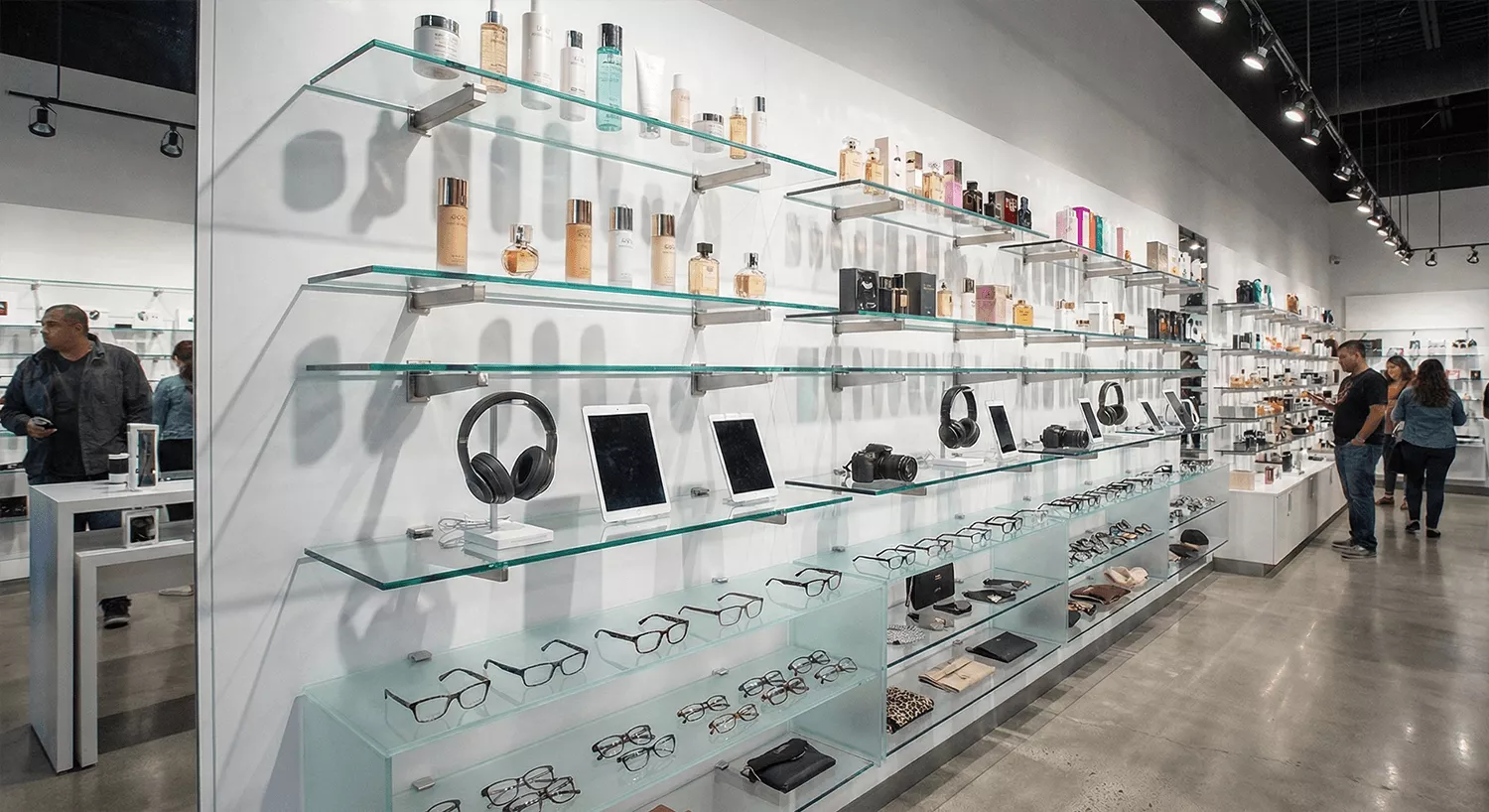
Table of Contents
- 1 What Are the Standard Glass Shelf Dimensions for Retail Displays?
- 2 How Do You Choose the Right Shelf Depth for Your Retail Use Case?
- 3 What Thickness Should Commercial Glass Shelves Be? (Based on Weight & Span)
- 4 Which Type of Glass Is Best for Retail Display Shelving?
- 5 What Are the Recommended Shelf Support Options?
- 6 How to Determine Correct Spacing Between Retail Glass Shelves
- 7 Real Retail Scenarios – Dimension Templates for Different Industries
- 8 Custom vs Standard Glass Shelves: Which Should You Choose?
- 9 Safety Requirements & Compliance
- 10 How to Measure Your Space Correctly (Step-by-Step)
- 11 Installation Considerations – What Retailers Often Get Wrong
- 12 Maintenance Guide: Keeping Glass Shelves Clean & Safe
- 13 Pricing Guide – How Much Do Retail Glass Shelves Cost?
- 14 Why Fab Glass and Mirror Is the Best Source for Retail Glass Shelving
- 15 Final Summary
- 16 FAQs
What Are the Standard Glass Shelf Dimensions for Retail Displays?
Retail display glass shelves typically fall within predictable size ranges based on product category and display purpose. Most stores use:
Standard Retail Glass Shelf Dimensions
| Shelf Type | Common Length | Common Depth | Recommended Thickness |
| General retail | 24″–48″ | 8″–12″ | 1/4″ – 3/8″ |
| Cosmetics & skincare | 18″–36″ | 6″–10″ | 1/4″ |
| Electronics | 24″–48″ | 10″–16″ | 3/8″ – 1/2″ |
| Eyewear | 18″–30″ | 6″–8″ | 1/4″ |
| Apparel accessories | 24″–48″ | 10″–12″ | 3/8″ |
| Heavy display/trophy | 24″–60″ | 10″–18″ | 1/2″ |
These ranges exist because they are proven to balance visibility, stability, and structural integrity.
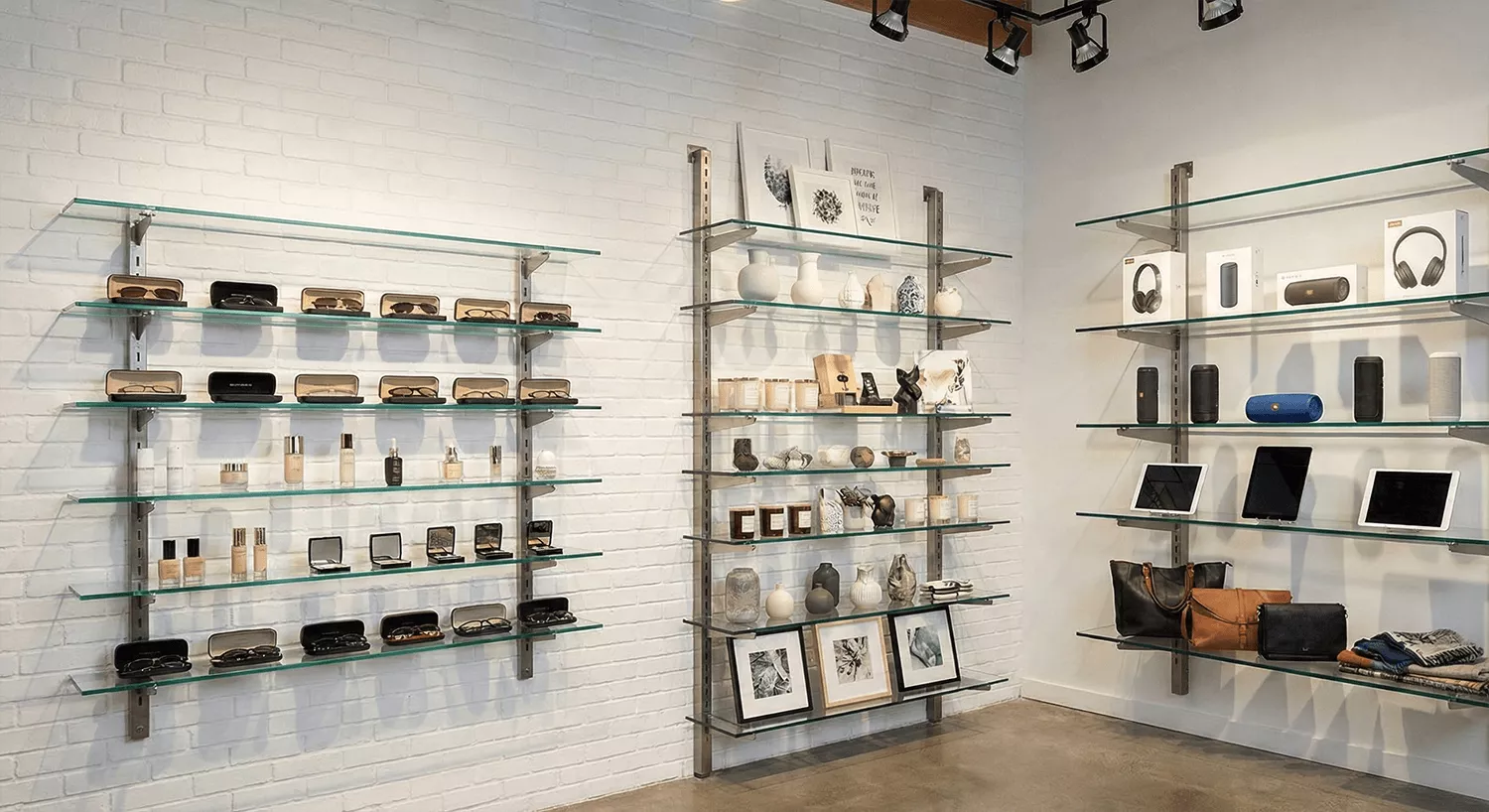
How Do You Choose the Right Shelf Depth for Your Retail Use Case?
Depth determines whether your products sit confidently or look awkward and unstable. Retailers often go too deep or too shallow. Listed below are depth guidelines by industry;
Cosmetics & Skincare Stores
- Ideal Depth: 6″–10″
- Why: Small bottles, perfumes, serums — deep shelves distort the visual grid.
Electronics Stores
- Ideal Depth: 10″–16″
- Why: Tablets, speakers, routers, headphones require real shelf real estate.
Gift Shops / Home Décor
- Ideal Depth: 8″–12″
- Why: Medium-weight items need stability without dominating wall space.
Eyewear Displays
- Ideal Depth: 6″–8″
- Why: Sunglasses and frames must sit close to edges for clean presentation.
Boutiques (Accessories)
- Ideal Depth: 10″–12″
- Why: Handbags, jewelry trays, and folded apparel need balance.
Common Mistakes
- Too Shallow: Items tip over or look crammed.
- Too Deep: Kills the minimalist retail aesthetic and reduces product visibility.
- Wrong Depth with Wrong Support: Leads to sagging or potential failure.

What Thickness Should Commercial Glass Shelves Be? (Based on Weight & Span)
Choosing thickness is not about appearance, it’s about glass shelving weight capacity and span length.
General Retail Shelf Thickness
| Shelf Length | Shelf Depth | Min Thickness | Weight Capacity |
| 24″ × 8″ | Light display | 1/4″ | 25–30 lbs |
| 36″ × 10″ | Medium load | 3/8″ | 35–55 lbs |
| 48″ × 12″ | Medium-heavy | 3/8″–1/2″ | 50–90 lbs |
| 60″ × 14″ | Heavy load | 1/2″ | 80–120 lbs |
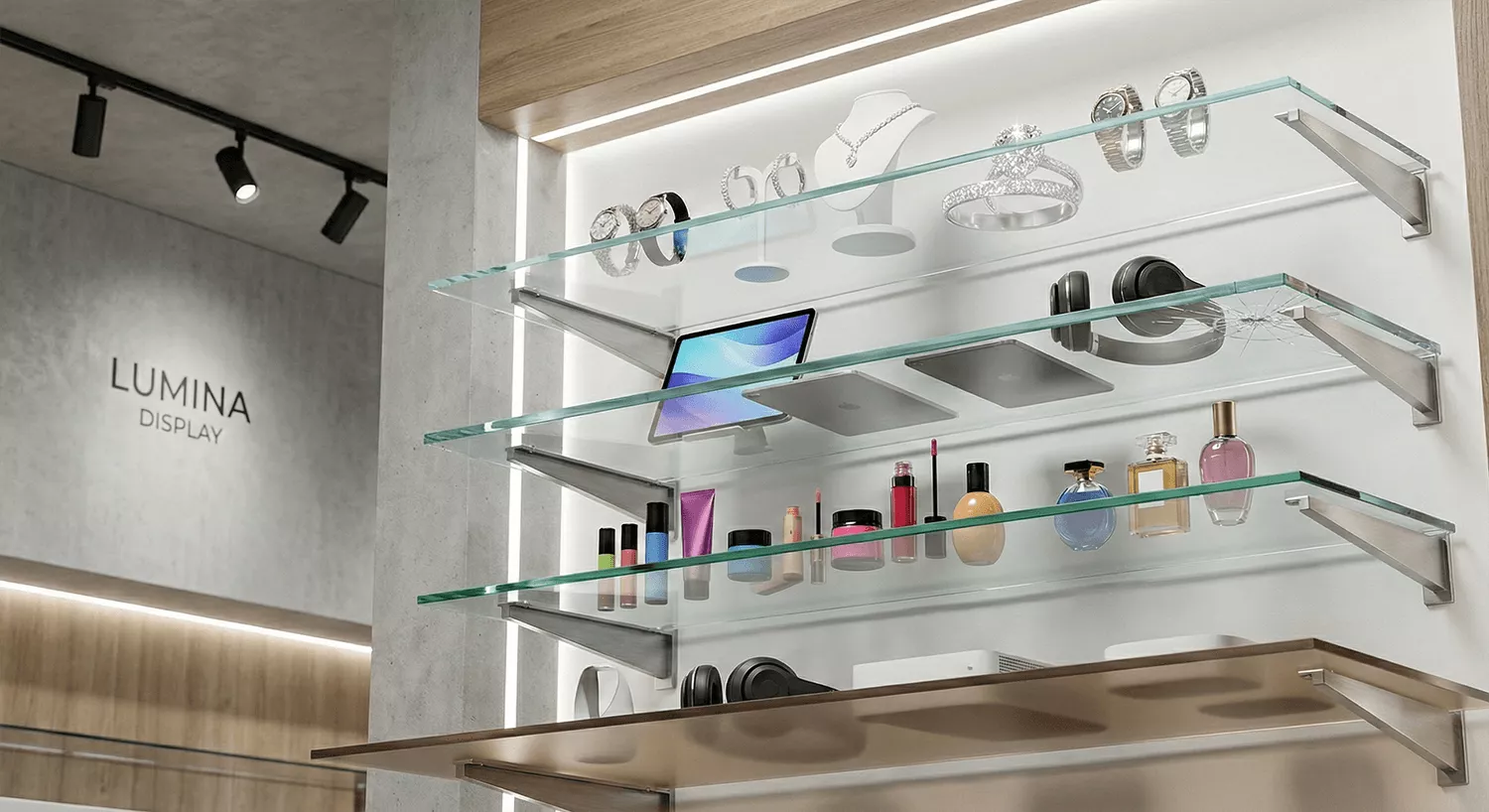
Key Rule of Thumb
- The longer the span → the thicker the glass.
- The deeper the shelf → the thicker the glass.
- Heavier product categories → thicker glass.
Safety First: Tempered or Laminated?
- Tempered glass is the gold standard: 4–5× stronger and safe shattering properties.
- Laminated glass is used for high-security or luxury environments where shatter containment matters.
- Annealed glass is not for retail shelves — too weak, too risky.

Which Type of Glass Is Best for Retail Display Shelving?
This is where most retailers settle for “whatever’s available,” and that is why their displays look generic or fail early.
1. Tempered Glass (Best for Most Stores)
- High strength
- Scratch-resistant
- Safe shattering behavior
- Cost-effective
2. Laminated Glass (Premium / High Security)
- Ideal for luxury stores, jewelry shops, or high-theft environments
- If it breaks, fragments stay adhered to the lamination layer
3. Low-Iron Glass (Ultra-Clear Premium Displays)
- Eliminates the green tint of standard glass
- Perfect for high-end cosmetics and jewelry
- Boosts color accuracy for visually critical products
4. Frosted/Tinted Glass (Aesthetic Applications)
Used where decoration matters more than clarity

What Are the Recommended Shelf Support Options?
The biggest dimension mistakes retailers make come from choosing the wrong support system.
1. Floating Shelf Brackets
- Clean, modern, minimal
- Works best with 3/8″ to 1/2″ tempered glass
- Span should not exceed 36″ without reinforcement
2. Standard Brackets
- High load capacity
- Good for electronics, décor, and heavy items
- Allows longer spans (48″–60″)
3. Clamp Brackets
- Stylish chrome or matte black clamps
- Best for boutique and cosmetics displays
- Works well with 1/4″ or 3/8″ glass
4. Slotted Standards
- Adjustable
- Best for modular retail environments
- Ideal when changing shelf heights frequently
Supports directly influence:
- Required glass thickness
- Maximum span
- Safety margins
- Visual style
How to Determine Correct Spacing Between Retail Glass Shelves
Spacing determines whether products look premium or cluttered.
Industry Spacing Guidelines
| Cosmetics & Small Items | 10″–14″ clearance |
| Eyewear | 8”-12” clearance |
| Boutiques & Accessories | 12”-16” clearance |
| Electronics | 12”-18” clearance |
| Gift Shops / Décor | 12”-18” depending on product height |
Strategic Tip: Use smaller spacing at eye-level, larger spacing above and below for natural visual flow.

Real Retail Scenarios – Dimension Templates for Different Industries
This is where retailers get their real value: plug-and-play dimension sets based on proven merchandising standards.
1. Cosmetics & Skincare Stores
Small product footprints mean shallow shelves + tight spacing = maximum density without clutter.
- Length: 24″–36″
- Depth: 6″–10″
- Thickness: 1/4″ tempered
- Spacing: 10″–14″
- Support: Clamps or slotted standards
2. Eyewear Displays
Eyewear needs minimal depth so frames sit forward and visible.
- Length: 18″–30″
- Depth: 6″–8″
- Thickness: 1/4″
- Spacing: 8″–12″
- Support: Floating or clamps
3. Boutique & Apparel Accessories
Medium-heavy items require sturdier glass and longer spans.
- Length: 24″–48″
- Depth: 10″–12″
- Thickness: 3/8″
- Spacing: 12″–16″
- Support: Brackets or floating
4. Electronics Stores
Electronics demand strength, depth, and stability.
- Length: 24″–48″
- Depth: 10″–16″
- Thickness: 3/8″–1/2″
- Spacing: 12″–18″
- Support: Heavy-duty brackets
5. Trophy Cases & Heavy Display Environments
Trophies and awards are dense — the glass must be bulletproof (figuratively).
- Length: 24″–60″
- Depth: 10″–18″
- Thickness: 1/2″
- Supports: Brackets or metal framing
Custom vs Standard Glass Shelves: Which Should You Choose?
When Standard Works
- Common size displays
- Simple merchandising
- Frequent shelf swapping
- Budget-focused projects
When Custom Is Mandatory
- Odd wall widths
- Premium, modern architecture
- Heavy products requiring reinforced design
- Brand-specific aesthetics
- Exhibition-level layouts
Cost Considerations
- Standard: Cost-efficient
- Custom: Higher ROI when design or load needs justify it
Safety Requirements & Compliance
If you are installing shelves in a retail store, safety is not optional. You must consider:
Building Codes: Some states require tempered glass in commercial display installations.
ASTM Standards: Retail-grade tempered glass should meet:
- ASTM C1048 (heat-treated glass)
- ANSI Z97.1 (Safety glazing materials)
Edge Finishing: Always choose polished edges — both for looks and to prevent cuts.
Load Testing: Shelves must be tested to hold at least 4× the expected load.
How to Measure Your Space Correctly (Step-by-Step)
This is one area retailers often screw up, leading to poor alignment, return shipments, or unsafe installations.
Step 1 — Measure the Width
- Use a metal tape measure
- Measure top, middle, and bottom
- Use the smallest number (walls are rarely perfect)
Step 2 — Measure Depth
- Measure from the wall out to where the shelf should end
- Consider door swing, traffic path, and ADA clearance
Step 3 — Find Perfect Level
- Use a laser level
- Mark support locations before ordering shelves
Step 4 — Account for Supports
- Brackets add visual space
- Floating systems require pre-measuring stud locations

Installation Considerations – What Retailers Often Get Wrong
A ruthless truth: retailers underestimate installation risks constantly. Here are the biggest mistakes to avoid:
Mistake #1 — Undersized Supports
Lightweight brackets can’t hold medium-weight loads safely.
Mistake #2 — Oversized Span Lengths
Long shelves require thicker glass — simple physics.
Mistake #3 — Using Non-Tempered Glass
This is dangerous and violates commercial safety standards.
Mistake #4 — Ignoring Wall Material
Drywall vs concrete vs wood all affect anchor selection.
Mistake #5 — Choosing Aesthetic Over Strength
Minimal doesn’t mean safe. Always balance both.

Maintenance Guide: Keeping Glass Shelves Clean & Safe
Daily Cleaning
- Use a microfiber cloth
- Use ammonia-free cleaners
- Avoid harsh scrubbing pads
Scratch Prevention
- Use rubber bumpers under décor
- Avoid dragging items
- Keep inventory movements smooth
Monthly Inspection
- Check brackets
- Look for chips
- Ensure no sagging or bending
Pricing Guide – How Much Do Retail Glass Shelves Cost?
Pricing varies based on size, thickness, edge work, and glass type.
General Price Ranges
For exact pricing, Fab Glass and Mirror provides fast custom quotes. However, listed below are estimated prices for different thicknesses;
- 1/4″ tempered: $25–$60 per shelf
- 3/8″ tempered: $45–$120 per shelf
- 1/2″ tempered: $80–$200+ per shelf
- Low-iron upgrades: +20–40% premium
- Custom shapes & cutouts: higher pricing based on complexity
Why Fab Glass and Mirror Is the Best Source for Retail Glass Shelving
If you want shelves that perform, last, and elevate your store, you need a supplier that understands retail grade requirements.
Fab Glass and Mirror offer;
- Precision-cut custom glass shelves
- Tempered and laminated retail-safe glass
- Low-iron ultra-clear options
- Fast turnaround
- Nationwide shipping
- Edge polishing, custom shapes, and thicknesses
We manufacture shelves meant to sell your products, not just store them.
Final Summary
Choosing the right glass shelf dimensions is about engineering, aesthetics, and safety — not guesswork. With proper sizing, thickness, spacing, and supports, your store will look cleaner, more premium, and more profitable. If you’re ready to upgrade your displays, order custom glass shelves from Fab Glass and Mirror, built to retail standards and precision cut to your space.
FAQs
Most retail shelves range from 24″–48″ long, 8″–12″ deep, and use 1/4″ to 3/8″ tempered glass, depending on product weight.
Use 1/4″ for light items, 3/8″ for medium loads, and 1/2″ for heavy or long-span shelving.
Tempered glass is the safest and strongest option for retail because it’s 4–5× stronger and meets commercial safety standards.
Depending on thickness and span, glass shelves hold 25–120 lbs. Thicker glass and shorter spans carry more.
Depth varies by industry:
1) Cosmetics: 6″–10″
)2 Eyewear: 6″–8″
3) Electronics: 10″–16″
4) Accessories: 10″–12″
Shelf spacing usually ranges from 10″–18″, depending on product height and display style.
Yes—if you use 3/8″–1/2″ tempered glass and keep spans under 36″. Brackets are better for heavier loads.
Yes. Building codes and ASTM standards recommend tempered glass for all retail and commercial display installations.
Choose custom shelves for odd wall sizes, premium store layouts, heavy products, or brand-specific display designs.