
My Cart
You have no items in your shopping cart.
Hardware mirrors are manufactured to residential tolerances: consistent enough for a bathroom vanity or hallway, but fundamentally unsuitable for any space where athletes, trainers, or students rely on accurate reflection feedback. These activity mirrors are engineered to a different standard: low-distortion optical flatness, minimum 1/4″ thickness for rigidity, polished safety edges, and vinyl safety backing that prevents dangerous fragmentation.
This guide breaks down exactly what separates these two product categories across every specification that matters: glass thickness, optical clarity, safety engineering, long-term durability, and fitness-specific performance requirements. If you are sourcing mirrors for a commercial fitness center, dance studio, martial arts dojo, yoga space, or home gym, understanding these distinctions will directly impact the quality and safety of your installation.For a deeper look at where to source gym mirrors, see our guide on the best places to buy gym mirrors: local vs. online.
Table of Contents
| Specification | Hardware Store Mirror | Commercial Gym Mirror |
| Typical Thickness | 1/8″ (3mm) | 1/4″ (6mm) standard; 3/16″ minimum |
| Reflection Accuracy | Moderate, prone to wave distortion | High, optically flat, low distortion |
| Optical Distortion Risk | High on large panels | Low with proper thickness and mounting |
| Safety Backing | None or minimal film | Vinyl safety backing (standard) |
| Edge Finish | Seamed or raw | Polished or flat-polished |
| Glass Type | Annealed (standard) | Annealed or tempered options |
| Lifespan in Active Use | 2–5 years typical | 10–20+ years with correct mounting |
| Gym Suitability | Not recommended | Designed for fitness environments |
| Large-Format Availability | Limited (up to 36″ x 60″) | Custom large panels up to 96″ or more |
| Long-Term Cost Efficiency | Poor (replacement costs accumulate) | High (durability offsets initial cost) |
| Distortion Under Vibration | Significant | Minimal with correct thickness |
| Safety Standard | Residential (Non-breakage) | ANSI Z97.1 & CPSC 16 CFR 1201 |

As this year observed a hike in gym memberships, most buyers entering the gym mirror market for the first time assume they are purchasing a larger version of a standard residential mirror. That assumption is incorrect and leads to some of the most common and costly sourcing mistakes in facility setup.
Standard mirrors prioritize aesthetics and are often thin, leading to “funhouse” warping. Gym mirrors are engineered as precision performance tools with 1/4″ thickness to ensure a 100% accurate reflection. This allows athletes to monitor biomechanics and correct form without the dangerous distraction of visual distortion.
For a full side-by-side breakdown of both product types, see our dedicated article on gym mirror vs. regular mirror comparison.
In resistance training, mirrors must accurately reflect joint alignment. Lifters use this feedback for micro-corrections to squat depth, knee tracking, and spinal neutrality. Thin or poorly mounted mirrors often have wave distortion, making these corrections unreliable. Consequently, distorted reflections reinforce poor mechanics over time rather than correcting them.
Research in motor learning supports this directly. A peer-reviewed study published in PMC (NIH) found that mirror visual feedback (MVF) significantly enhances movement accuracy and inter-manual transfer in sport-specific tasks, benefits that depend entirely on the quality and accuracy of the reflected image.
Dance and yoga studios require absolute precision. Alignment work relies on mirror feedback for both individual and group instruction. Inconsistent reflections across a wall lead to inaccurate feedback, an unacceptable outcome for professional studio settings.
A clinical study on mirror feedback in group exercise settings (published in PMC, 2025) found that accurate visual feedback from mirrors facilitates technical precision in the early stages of motor learning, reinforcing the case for distortion-free commercial panels in studio environments.
Commercial fitness mirrors also function architecturally. A full-length mirror wall expands the perceived volume of a space, which is particularly important in smaller training rooms. Low-distortion commercial panels create a seamless, continuous reflection that reinforces spatial depth. Hardware store mirrors, particularly when tiled in smaller sections, create seam artifacts, reflection breaks, and visual fragmentation that disrupts both the training environment and room aesthetics.

Optical distortion is the most technically significant differentiator between residential and commercial-grade mirrors. Understanding why distortion occurs, and how commercial mirrors are engineered to minimize it, is essential for any serious buyer.
Glass is not perfectly rigid. All glass panels flex to some degree under their own weight, particularly at larger dimensions. A 1/8″ (3mm) thick panel measuring 48″ x 72″ has insufficient structural rigidity to maintain optical flatness when mounted vertically. The panel bows slightly at the center, creating what is technically described as a cylindrical or toroidal surface deviation. The result is a reflection that compresses or elongates the image horizontally or vertically, conversationally known as a “funhouse mirror effect”.
The relationship between thickness, panel size, and distortion is proportional: as panel size increases and thickness remains constant, distortion risk increases exponentially rather than linearly. This is why a 1/8″ mirror in a small 24″ x 36″ format may appear acceptable, while the same thickness at 48″ x 84″ will almost certainly distort.
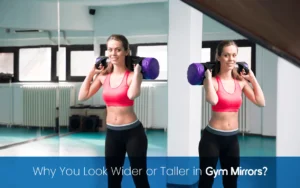
This distortion directly affects how athletes perceive their own body in training environments. For a detailed explanation of this perceptual effect, see our article on why you look wider or taller in gym mirrors.
Even a correctly specified mirror will distort if mounted against an uneven wall surface. Standard drywall construction tolerates surface variations of up to 1/4″ over 8 feet, a tolerance perfectly acceptable for paint, but problematic for mirror mounting. When a mirror panel bridges an uneven surface, the glass conforms to the wall’s topography, introducing curvature directly into the reflective plane.
Even high-quality glass deviates by measurable amounts across large surface areas, making wall preparation a critical variable in mirror optical performance.
Fitness environments generate vibration. Dropped weights, treadmill motors, jumping and impact training, and HVAC systems all create low-frequency vibrations that propagate through building structures. Thin mirror panels respond to these vibrations by oscillating at their natural resonant frequency, creating a dynamic ripple distortion visible to the human eye during training. Commercial-grade panels at 1/4″ or greater thickness have significantly higher mass and rigidity, substantially dampening vibration-induced distortion.
The practical consequence of optical distortion extends beyond aesthetics. Athletes training with distorted mirror feedback report difficulty accurately perceiving body alignment, spatial orientation, and movement symmetry. In competitive athletics, dance, and rehabilitative physical therapy, this feedback inaccuracy is clinically significant. Commercial gym mirrors are not an upgrade, for professional applications, they are the minimum acceptable specification.
Commercial fitness mirrors are defined by a specific cluster of specifications that distinguish them from decorative residential products. Each specification addresses a functional requirement unique to active, large-format, high-use environments.
| Specification | Commercial Standard | Performance Implication |
| Glass Thickness | 1/4″ (6mm) minimum; 3/8″ for large spans | Rigidity, distortion resistance, vibration damping |
| Panel Width | Up to 72″ wide; custom sizes available | Fewer seams, cleaner reflection continuity |
| Panel Height | Standard 84″ or floor-to-ceiling custom | Full-body visibility; proper posture assessment |
| Edge Finish | Flat polished or beveled-free polished | Safety and professional appearance |
| Safety Backing | Vinyl laminate film | Holds fragments on breakage; reduces injury risk |
| Glass Type | Annealed (float glass); tempered optional | Annealed offers easier edge work; tempered adds impact resistance |
| Silver Coating | Double-coat silver with copper barrier | Oxidation resistance; reflection longevity |
| Surface Flatness | Optical-grade float process | Low-distortion reflection across full panel |
| Frame | Frameless (standard); channel or J-trim optional | Frameless maximizes reflective area; clean aesthetic |
All commercial-grade mirror glass begins as float glass, produced by floating molten glass on a bath of molten tin to achieve uniform thickness and exceptional surface flatness.
Commercial gym mirrors are typically available in custom-cut formats, allowing facilities to specify exact dimensions rather than working around standard residential sizes. A 48″ x 84″ panel covers 28 square feet of wall area and eliminates the seam count that smaller tiles would introduce. Fewer seams mean fewer reflection breaks and a cleaner, more professional training environment.
The reflective coating on an activity gym mirror is not a single silver layer. Quality commercial mirrors use a double-coat silver process with a copper barrier layer and protective paint backing. This construction provides oxidation resistance that extends mirror lifespan significantly in humidity-prone environments like fitness facilities, where sweat vapor and temperature fluctuations accelerate the degradation of lower-grade mirror coatings. Edge-sealing is an additional quality indicator; sealed edges prevent moisture intrusion at the most vulnerable point of the coating stack.

Mirror thickness is the single most determinative specification for optical performance. Each increment in thickness meaningfully changes how a mirror panel behaves at gym-relevant dimensions.
| Thickness | Metric | Use Case | Distortion Risk | Max Recommended Width |
| 1/8” | 3mm | Small decorative mirrors only | Very high | 24” |
| 3/16” | 4.5mm | Residential, small gym panels | Moderate | 36” |
| 1/4″ | 6mm | Commercial gym standard | Low | 48” – 60” |
| 3/8” | 9.5mm | Large span commercial, Premium Installs | Very Low | 72”+ |
At 3mm, glass has minimal structural rigidity at any dimension larger than a bathroom vanity. The panel bends under its own weight when mounted vertically, and any imperfection in the mounting surface is transmitted directly into the reflective plane. Hardware stores predominantly stock 1/8″ mirrors in their standard inventory. These panels may be acceptable for decorative residential use but represent a liability in any performance environment.
A 4.5mm panel offers improved rigidity over 1/8″ and may be acceptable for gym applications at smaller panel sizes (under 36″ wide). Mirrors between 24″ and 48″ wide are commonly specified at 3/16″ for residential use, but this thickness still carries meaningful distortion risk at full-height gym panel dimensions, particularly under vibration.
A quarter-inch panel provides the rigidity threshold at which optical distortion becomes negligible for standard gym mirror dimensions. A 6mm glass offers sturdier performance where movement or temperature change might otherwise cause flexing, making it the correct baseline specification for any professional installation.
For very large format panels exceeding 60″ in width, or in environments with significant vibration exposure, 3/8″ glass offers superior rigidity and distortion resistance. The added mass also improves vibration damping performance. This specification is used in high-end dance studios, broadcast-quality fitness facilities, and architectural mirror wall systems where optical precision is paramount.
Mirror safety is not a secondary consideration in fitness environments. Large-format mirror panels represent a significant injury risk if they break without containment, a fact often not considered until after an incident has occurred. The safety features built into commercial gym mirrors address this risk at multiple levels.
Vinyl safety backing is a laminate film bonded to the rear face of the mirror. Its function is containment: if the mirror breaks, from impact, thermal stress, or mounting failure, the vinyl film holds the fragments in place rather than allowing them to cascade into the training space. This is not a minor feature. A shattering mirror without safety backing produces razor-edged glass fragments that can cause severe lacerations. Commercial gym mirrors should always specify safety backing as a non-negotiable requirement.
The choice between tempered and annealed glass involves trade-offs that are often misunderstood (read our article on Annealed Vs Tempered Glass – A Brief Comparison). Tempered glass is approximately four times stronger than annealed glass of equivalent thickness, and when it breaks, it fractures into small, relatively rounded fragments rather than sharp shards. This is why tempered glass is mandated in many building applications.
However, for mirrors specifically, tempered glass has a practical limitation: it cannot be cut after tempering. This means tempered mirrors must be ordered to exact final dimensions before the tempering process. Annealed mirrors, by contrast, can be custom cut mirrors at the time of order. For complex gym layouts requiring non-standard dimensions, annealed glass with vinyl safety backing is often the more practical specification.
Raw or seamed glass edges are sharp enough to cause lacerations during handling and mounting. Commercial grade gym mirrors should always specify polished edges, a mechanical grinding and polishing process that rounds and smooths the cut glass edge. Flat polishing is standard; beveling adds cost without functional benefit for gym applications. For frameless mirrors with visible edges, polished edges are also an aesthetic requirement.
In commercial fitness environments, mirrors should be evaluated against ANSI Z97.1 and CPSC 16 CFR 1201 safety standards for glazing materials. These frameworks define the fracture behavior requirements that inform commercial mirror specifications. The ANSI Z97.1 standard, maintained by the Glazing Industry Secretariat Committee, establishes minimum safety performance characteristics for all safety glazing materials used in buildings, including mirror glazing in fitness facilities. Buyers sourcing mirrors for commercial applications should confirm compliance with applicable standards in their jurisdiction.
Effective mirror layout planning is a design discipline that directly affects training utility, spatial perception, and long-term satisfaction with a mirror installation. The decisions made at the planning stage, wall coverage, mirror height, panel arrangement, seam placement, cannot be easily corrected after installation.
For commercial fitness environments, the generally accepted standard is full-width wall coverage at a minimum height of 7 feet from the floor. This provides complete visibility for standing exercises and most floor-based movements. Partial mirror walls, particularly those that cut off the lower body or the head, severely compromise the functional value of the installation.
In larger facilities, activity mirrors are typically planned on one or two primary training walls rather than all four. Mirror placement opposite windows should be avoided where possible, as direct sunlight creates glare and reflection artifacts that degrade image quality.
The lower edge of the mirror should be positioned no more than 8–12 inches from the floor to capture full-body reflection for floor movements, deadlifts, and low-position training. The upper edge should extend to at least 84 inches (7 feet) from the floor, and ideally to ceiling height for tall spaces. Dance and yoga studios frequently run mirrors from floor to ceiling to support full-range movement visibility.
Seams between mirror panels are unavoidable in most installations. The goal of layout planning is to minimize their visual impact and ensure they do not interfere with primary training positions. Vertical seams should be placed at natural spatial intervals, not directly in front of common training positions. For a 10-feet-wide training station, a seam at the 5-foot midpoint creates a visual split at exactly the position where reflection accuracy matters most.
Horizontal seams, where panels are stacked vertically, should be positioned to avoid cutting across the torso or face in standing position. A horizontal seam at 48 inches from the floor bisects the midsection of most adult users, a particularly disruptive placement for posture assessment. Planning panel dimensions to place any horizontal seam above head height or below knee height minimizes training disruption.
Home garage gyms present specific layout challenges. Ceiling heights vary (typically 8–10 feet), wall widths are often irregular, and concrete block or drywall surfaces may require additional preparation. For garage applications, a single wall of full-height mirrors is typically sufficient. Panel sizing should account for any obstructions, electrical panels, service doors, ventilation fixtures, and seam placement should be planned around the primary squat rack or barbell training position.
Dance studios and yoga spaces typically require floor-to-ceiling mirror coverage on one primary wall and, in larger spaces, a secondary wall. The absence of frames creates a clean, uninterrupted reflective surface that is both functionally and aesthetically correct for these applications. Pilates reformer studios may require mirrors on a side wall rather than a front wall to capture lateral movement planes.
The initial price difference between hardware store mirrors and commercial gym mirrors is real but routinely misunderstood as representing equivalent value at different price points. The relevant comparison is not unit cost, but total gym mirror cost over the useful life of the installation.
| Cost Factor | Hardware Store Mirror | Commercial Gym Mirror |
|---|---|---|
| Initial Unit Cost | Lower (approx. $3–8/sq ft) | Higher (approx. $8–20/sq ft) |
| Expected Lifespan | 2–5 years in active use | 10–20+ years with correct mounting |
| Replacement Frequency | High — distortion, edge damage, breakage | Low — engineered for durability |
| Distortion Complaints | Common after 1–2 years | Rare with correct spec and mounting |
| Safety Incident Risk | Higher — no safety backing standard | Low — vinyl backing standard |
| Liability Exposure | Higher in commercial settings | Reduced by safety backing and edge finish |
| Edge Damage Rate | High — raw edges chip easily | Low — polished edges resist chipping |
| Coating Longevity | Oxidation common in 3–5 years | Double-coat silver resists 15+ years |
| Total 10-Year Cost | 3–5x initial cost (replacements) | Near initial cost (minimal replacement) |
For buyers operating under budget constraints, our cheapest gym mirrors: budget guide for beginners explains how to identify the best value commercial options without compromising on critical specifications like thickness and safety backing.
The 10-year cost analysis consistently favors commercial-grade mirrors. A hardware store mirror installation that requires replacement every 3–4 years costs 2.5–4× its initial price over a decade, excluding the labor cost of removal and remounting. A commercial mirror installation that performs without replacement for 15+ years is significantly more economical even at double the initial unit price.
Home garage gyms require mirrors that can handle temperature fluctuation, occasional impact, and mounting on surfaces that may not be perfectly flat. The recommended specification is 1/4″ annealed with vinyl safety backing and polished edges. Single-panel or two-panel configurations on the primary training wall provide sufficient coverage. Custom-cut panels are preferable to avoid the visual disruption of multiple small tiles.
Yoga studios prioritize a calm, undistorted reflection environment. Full floor-to-ceiling coverage on the front wall is standard. Low-distortion optical clarity is the primary specification requirement. Frameless panels with polished edges create a clean visual field. 1/4″ thickness at standard panel dimensions is appropriate for most yoga studio configurations.
Pilates mirrors serve a functional role in reformer-based and mat work instruction. Side-wall placement is common to capture lateral and sagittal plane movement. Custom panel sizing to fit between reformer positions is often required. 1/4″ commercial panels with safety backing are the correct specification. Horizontal seam placement must be planned carefully given the floor-based nature of much of the work.
Dance studios have the most demanding mirror requirements of any fitness application. Floor-to-ceiling coverage is standard, and the reflective surface must be consistent across the full width of the wall to support group instruction. 1/4″ minimum thickness, and 3/8″ for large spans, is recommended. Multiple wall coverage (front and side) is typical in professional dance facilities.
Martial arts dojos and MMA facilities have a higher-than-average impact risk from thrown equipment and body contact near walls. For these environments, tempered mirror glass provides additional impact resistance. Alternatively, 1/4″ annealed with vinyl safety backing provides adequate containment in most configurations. Mirror placement should account for safety zones; mirrors should not be positioned where a practitioner could be thrown or fall into them directly.
Physical therapy environments require mirrors with exceptional optical accuracy for gait analysis, postural assessment, and movement rehabilitation. In these settings, reflection distortion can interfere with clinical assessments. Commercial gym mirrors at 1/4″ or 3/8″ thickness, full floor-to-ceiling height, and minimum-seam configuration are the appropriate specification.
Large commercial fitness centers require the highest volume of mirror coverage and typically have the most complex layout requirements. Standard specification is 1/4″ commercial mirror panels with vinyl safety backing, polished edges, and custom sizing to maximize wall coverage efficiency. Weight room areas should be assessed for vibration exposure, and 3/8″ panels may be warranted near heavy drop zones.
The most frequently cited mistake in gym mirror procurement is selecting the lowest-cost option without evaluating performance specifications. A 1/8″ hardware mirror may be 40% cheaper per square foot at point of purchase. Over three years of active gym use, the same buyer will typically have replaced that mirror once and is beginning to see distortion in the replacement, having already exceeded the cost of the correct commercial product.
Specifying 1/8″ or 3/16″ glass for panels larger than 36″ wide is a reliable predictor of distortion complaints. The physics of glass rigidity do not allow adequate performance at these dimensions and thicknesses. No amount of careful mounting corrects for insufficient glass rigidity in large-format applications.
Optical distortion is extremely difficult to assess from a small sample or a product photograph. Buyers who do not test-view commercial samples at the same distance they will use in their facility frequently discover distortion only after full installation. Reputable commercial mirror suppliers provide sample panels or reference installations for evaluation.
Beveled mirrors introduce angled edges that refract light differently from the main reflective surface, creating an optical frame effect. In residential decorative settings, this is desirable. In training environments, any edge treatment that alters reflection geometry is a liability. Beveled edges also reduce the effective reflective area at panel edges and create visual distractions at seams. Gym mirrors should always specify flat polished edges, not beveled.
Sourcing mirrors without vinyl safety backing for any commercial fitness application is an unacceptable safety decision. The liability exposure from a shattering unsupported mirror in a training environment is substantial. Safety backing is not an upgrade; it is a baseline requirement for commercial use.
Under-covering the mirror wall is a common and difficult-to-correct planning error. Buyers who install mirrors to 60″ height rather than 84″ or ceiling height discover immediately that lower-body feedback is compromised. Planning wall coverage to full height and full width from the outset is always more cost-effective than supplementing an insufficient initial installation.
Bathroom mirrors, vanity mirrors, and decorative wall mirrors are produced to residential tolerances with features that are counterproductive in training environments. Decorative framing reduces reflective area and adds protrusions that create edge-chip risk in active spaces. Vanity mirror coatings are not rated for the humidity and temperature fluctuation common in fitness facilities. These products are not substitutes for commercial gym mirrors at any price point.
The gap between hardware store mirrors and commercial gym mirrors is not a matter of degree, it is a matter of engineering category. Hardware store mirrors are designed, manufactured, and tested for residential decorative applications. They meet their intended specification adequately. They are simply the wrong product for fitness environments.
Commercial gym mirrors address every performance requirement that residential mirrors fail to meet: sufficient glass thickness to maintain optical flatness at large-format dimensions, low-distortion reflection for movement feedback accuracy, vinyl safety backing for fragment containment, polished edges for handling and mounting safety, and coating durability for the temperature and humidity conditions of active fitness spaces.
The long-term cost analysis reinforces what the performance comparison establishes: commercial-grade mirrors are more economical over a 10-year ownership period even at a higher initial unit cost. The replacement cycles, distortion complaints, and safety liability exposure associated with residential mirrors in commercial fitness environments eliminate their apparent price advantage within the first few years of use.
For any application, garage gym, commercial fitness center, dance studio, yoga space, physical therapy clinic, or martial arts studio, the correct specification is 1/4″ commercial glass, vinyl safety backing, polished edges, and custom panel sizing that minimizes seams while maximizing wall coverage. This is not a luxury specification. It is the baseline from which commercial mirror performance begins.
Commercial gym mirrors should be a minimum of 1/4″ (6mm) thick. This is the industry standard thickness at which optical flatness is maintained across standard gym panel dimensions (up to 48″ wide). For panels wider than 60″, 3/8″ (9.5mm) is recommended. Thinner mirrors, 1/8″ or 3/16″, are not suitable for gym applications due to high distortion risk at large panel sizes.
Gym mirrors distort when the glass panel lacks sufficient rigidity to maintain a flat reflective surface. Distortion is caused by insufficient glass thickness, mounting against an uneven wall surface, vibration from gym equipment, and thermal expansion in improperly sealed panels. See our full explainer on why you look wider or taller in gym mirrors for a detailed breakdown of this effect.
Tempered gym mirrors are stronger and fracture into safer fragments when broken. However, they must be ordered to exact final dimensions before the tempering process and cannot be cut to size afterward. Annealed mirrors with vinyl safety backing are more flexible for custom layouts and provide adequate safety when the backing is properly specified. For most gym applications, annealed with vinyl safety backing is the preferred specification due to its flexibility.
Bathroom mirrors are not suitable substitutes for commercial gym mirrors. They are typically 1/8″ thick, insufficient for large-format gym applications, and are not produced with safety backing, polished edges for large panel applications, or coatings rated for fitness facility environments. The cost difference rarely justifies the optical and safety compromises.
For a garage gym, the ideal specification is 1/4″ thick commercial grade mirror with vinyl safety backing, polished edges, and custom sizing to fit the primary training wall. A single panel or two-panel configuration on the wall facing the primary training position provides adequate coverage. Frameless construction maximizes reflective area in typically space-limited garage environments.
Yes. Safety backing is a non-negotiable requirement for any commercial fitness environment. Vinyl safety backing holds glass fragments in place on breakage, preventing injuries from cascading glass shards. In commercial facilities, the liability exposure from an unsupported mirror failure is significant. For home gyms, safety backing is strongly recommended, particularly in high-traffic or shared-use spaces.
The primary prevention strategies for gym mirror distortion are: specify 1/4″ or thicker glass for any panel wider than 36″; ensure wall surfaces are flat before mounting (within 1/8″ variation over 8 feet); use appropriate mounting hardware or standoffs that distribute pressure evenly; and avoid mounting mirrors near high-vibration equipment without adequate vibration damping.
The standard minimum height for gym mirrors is 84 inches (7 feet) from the floor. For dance studios and professional fitness facilities, floor-to-ceiling height is preferred. The lower edge should be no more than 8–12 inches from the floor to capture lower-body reflection for floor-based and low-position exercises.
Optical distortion in mirrors is any deviation from a perfectly flat reflective surface that causes the reflected image to appear stretched, compressed, wavy, or geometrically inaccurate. In gym mirrors, optical distortion is most commonly caused by insufficient glass thickness, allowing the panel to bow under its own weight or flex against an uneven mounting surface. It is evaluated by viewing straight lines, like door frames or horizontal surfaces, in the mirror. Any curvature or wave in the reflected line indicates distortion.
Commercial gym mirrors with 1/4″ glass, quality silver coating, vinyl safety backing, and correct mounting typically last 15–20 years or more. The most common causes of premature failure are coating oxidation from moisture penetration (preventable with edge sealing), edge chipping from impact (reduced by polished edges), and physical breakage from direct impact. Hardware store mirrors in gym environments typically require replacement within 2–5 years.
Multiple smaller mirrors can cover a wall, but the seam count increases with each additional panel, creating reflection breaks that are visually disruptive and can interfere with training feedback. Large-format commercial panels (48″–72″ wide) minimize seams and provide a more continuous, professional reflection surface. If smaller panels must be used, seam placement planning becomes critical to minimize training disruption.
Frameless construction is strongly preferred for gym mirrors. Frames reduce reflective area, create edge protrusions that are an injury risk in active spaces, and visually fragment the mirror wall. Frameless panels with polished edges provide maximum reflective coverage, cleaner aesthetics, and eliminate protrusion hazards. J-channel or mirror channel trim is an acceptable alternative to full frames where edge support is required.
Vinyl safety backing is a laminate film bonded to the rear face of a mirror panel. When the mirror breaks, the film holds the glass fragments together, preventing dangerous scatter. It is the standard safety specification for commercial gym mirrors and is required by many building codes for large-format glazing in occupied spaces.
Tempered glass is not universally required for gym mirrors, though some building codes mandate it for glazing in certain configurations. Annealed glass with vinyl safety backing meets commercial safety requirements for most jurisdictions and gym applications. Buyers should verify applicable local building codes and consult ANSI Z97.1 safety glazing requirements for their specific application.
For guidance on sourcing decisions, local glass shops vs. online specialty suppliers, see our dedicated guide on the best place to buy gym mirrors: local vs. online.

Explore all things glass—from stylish table tops and insulated options to tinted and frosted designs. Discover guides on glass railings, custom cut glass, shelves, and stunning backsplash ideas for a modern home or office upgrade.