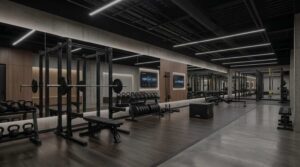
However, the true benefits of a dedicated gym mirror go far beyond merely checking your reflection.
Depending on the environment, the right workout mirror serves as a tool for safety, a driver of business revenue, or an architectural solution for cramped spaces. To help you understand the exact advantages for your specific setup, we at Fab Glass and Mirror have broken down the unique benefits of gym mirrors across various commercial and residential setups.
Commercial Spaces: Business, Safety, and Group Dynamics
1. Commercial Gym Mirrors: Branding, Aesthetics, and Liability Protection
In a high-traffic commercial fitness center, gym mirrors serve a critical dual purpose: risk mitigation and marketing.
Liability Reduction: Commercial-grade mirrors are built with heavy-duty safety backing. In the rare event that a misplaced barbell strikes the glass, the mirror cracks but holds together instead of shattering into dangerous shards, protecting your business from costly liability claims.
Organic Marketing: In the modern fitness landscape, members actively look for aesthetically pleasing backgrounds for social media check-ins. High-clarity commercial mirrors enhance gym aesthetics, making the facility look premium, modern, and highly shareable online.
Trainer-to-Client Coaching Autonomy: For personal trainers, mirrors act as a hands-off teaching aid. Instead of physically adjusting a client or invading their personal space, trainers can stand back and use the mirror to point out structural adjustments, boosting client comfort and professional boundaries.
Zone Safety and Foot Traffic Flow: In busy gyms, people walk around carrying heavy weights. Large mirrors allow members to see behind and around them before stepping backward with loaded dumbbells or exiting a lifting platform, drastically reducing accidental collisions.
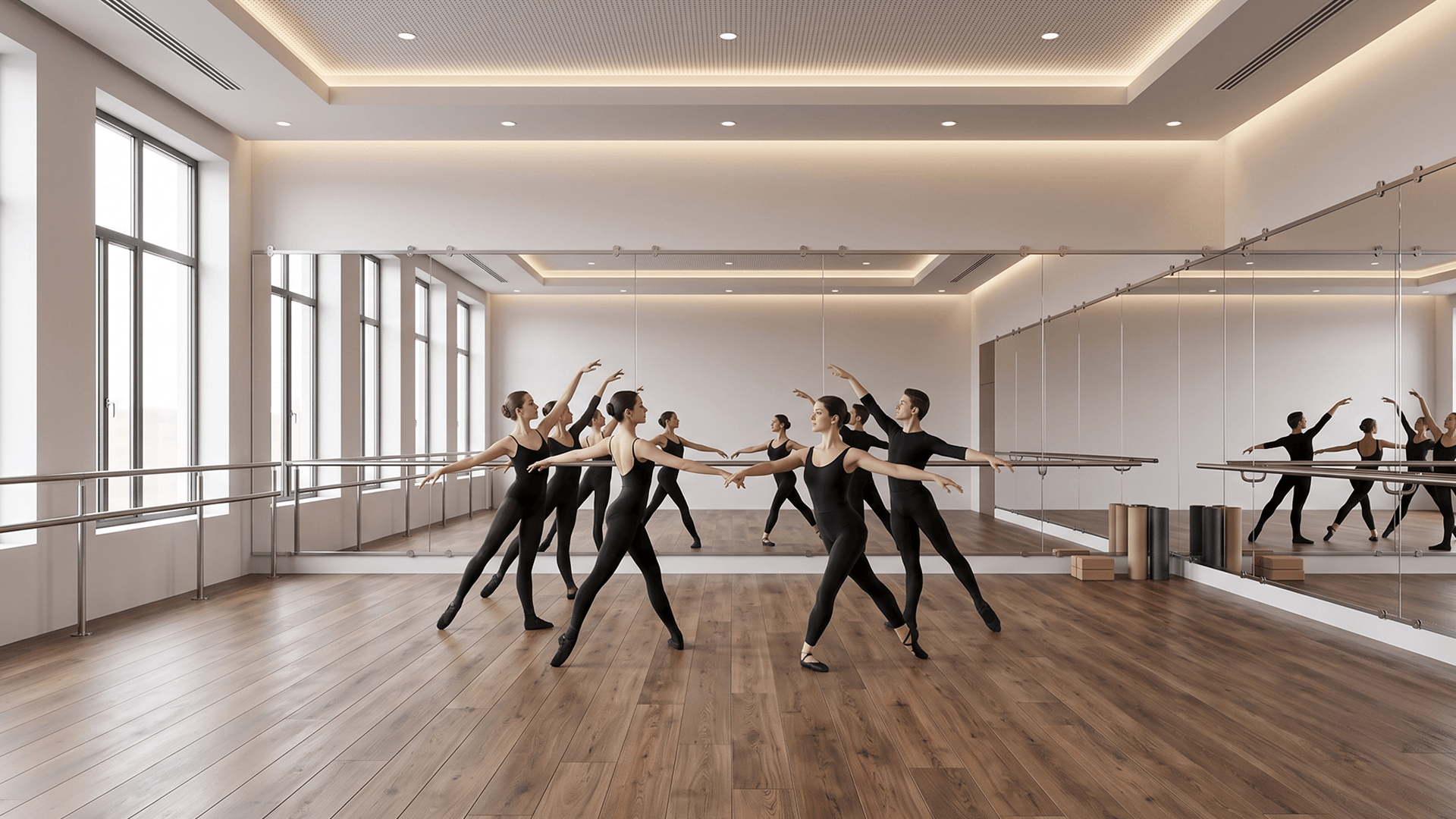
2. Dance Studio Mirrors: Spatial Synchronization and Choreography Tracking
For dance instructors and students, the primary benefit of a mirror installation is collective spatial awareness.
Group Synchronization: Unlike independent lifters, dancers must move as a single cohesive unit. Seamless, wall-to-wall interlocking mirrors allow dancers in the second and third rows to track the lead choreographer’s movements perfectly without blind spots.
Fluid Motion Tracking: Dance requires monitoring rapid, full-body transitions from footwork to arm extensions simultaneously. Dedicated studio mirror ensures there is zero warping across the seams, allowing dancers to maintain their lines and timing across the entire length of the room.
Prop and Costume Geometry Calibration: In routines involving ribbons, canes, or flowing skirts, dancers must judge the visual geometry of their gear. High-clarity mirrors allow them to evaluate how the costumes and props move through the air to ensure identical visual shapes across the ensemble.
Stage Front Simulation: The mirror wall naturally dictates the “downstage” line. It teaches dancers where to project their facial expressions and eye lines, training them to look toward an imaginary audience even when executing complex, blind turning maneuvers.
3. Pilates & Yoga Studio Mirrors: Low-Angle Horizontal Alignment
Pilates and yoga practices happen primarily close to the ground, changing the fundamental requirement of the workout mirror.
Floor-Level Visibility: The unique benefit here is low-angle alignment tracking. Because clients are frequently positioned on yoga mats or Pilates reformers, the gym mirrors must extend completely to the floor level. This allows practitioners to monitor their spinal alignment, hip leveling, and core engagement during horizontal movements without straining their necks.
Mindfulness & Breathing Symmetry: Seeing the rhythmic rise and fall of the torso during complex balance poses helps clients synchronize their breathing with physical transitions, deepening the mind-body connection.
Visual Proprioception for Micro-Movements: Pilates and yoga rely on minute, internal adjustments, like a half-inch pelvic tilt or a subtle scapular depression. Mirrors provide the exact visual confirmation needed to master these micro-movements when internal body awareness isn’t enough.
Asymmetry Identification for Rehabilitative Therapy: Many clients use yoga and Pilates to recover from injuries or manage conditions like scoliosis. Full size gym mirrors allow clients to actively see if one hip is hitching higher or if a shoulder is drooping during static holds, aiding in physical rehabilitation.
4. Martial Arts Dojo Mirrors: High-Impact Shock Absorption
Martial Art Studios and Dojos handle intense physical impacts, meaning their gym mirrors must possess entirely different structural benefits than a standard fitness studio.
Impact Resilience: Between takedowns, throws, and sparring, the walls of a dojo experience significant vibration. True dojo mirrors are installed using specialized mastic and J-channels designed to absorb structural shockwaves without cracking.
Peripheral Vision Training: In martial arts, looking directly at your opponent can leave you vulnerable. Large-format mirrors allow martial artists to train their peripheral vision, helping them track incoming strikes or simulate multiple attackers in their wider field of view.
Combat Guard Blind-Spot Detection: When throwing strikes, fighters often unconsciously drop their hands, leaving their chin or ribs exposed. Training in front of a mirror allows martial artists to spot these split-second guard drops and defensive blind spots in real-time.
Kata and Poomsae Angular Precision: Traditional martial arts forms require movements at highly specific angles (e.g., exact 45-degree pivots). Large activity gym mirrors allow practitioners to verify that their stances and weapon trajectories are geometrically perfect relative to the room’s grid.
Residential Spaces: Optimization, Atmosphere, and Motivation
1. Home Gym Mirrors: Personal Accountability and Goal Tracking
For a dedicated spare-room fitness space, the mirror acts as your silent, objective personal trainer.
Independent Form Auditing: Without a coach present, home exercisers easily fall into poor lifting habits. A high-quality home gym mirror provides immediate visual feedback, allowing you to self-correct your posture mid-set to prevent injury.
Psychological Momentum: Watching your physical progression and muscle engagement in real-time creates a powerful psychological feedback loop that boosts workout consistency and personal accountability.
Virtual Class and Screen Alignment: If you follow virtual workouts on a tablet or screen, placing it near your gym mirror allows you to align your gaze. You can match the instructor’s exact cadence and form side-by-side without continuously turning your head away from your workout line.
Asymmetrical Fatigue Recognition: When working out alone, it’s hard to tell when your muscles are unevenly tiring out. A home gym mirror reveals when your dominant side starts taking over, such as your left arm lagging slightly behind on a bench press, allowing you to stop the set before injury occurs.
2. Basement Gym Mirrors: Illumination Amplification and Anti-Claustrophobia
Basements are notorious for being dark, cramped, and uninspiring. Strategic mirror placement completely rewrites this environment.
Light Maximization: Basements generally suffer from poor natural light. Wall-to-wall mirrors act as passive amplifiers, bouncing light from your overhead fixtures across the entire room to completely eliminate dark corners.
Overcoming Low Ceilings: Vertical mirror panels create a powerful optical illusion that makes low basement ceilings feel significantly higher, transforming a claustrophobic cellar into an open, inviting training oasis. (For more layout inspiration, check out our guide on basement home gym ideas).
Utility Camouflage and Flaw Concealment: Basements often feature ugly exposed pipes, wiring, or uneven concrete foundation blocks. Hanging large-format mirrors serves as an instant architectural cover-up, hiding industrial eye-sores behind a clean, professional wall surface.
Psychological Atmospheric Warmth: Basements can feel cold, damp, and uninviting, which kills workout motivation. By reflecting ambient lighting and eliminating shadows, mirrors break the psychological “dungeon vibe,” making the basement feel warmer and more inviting.
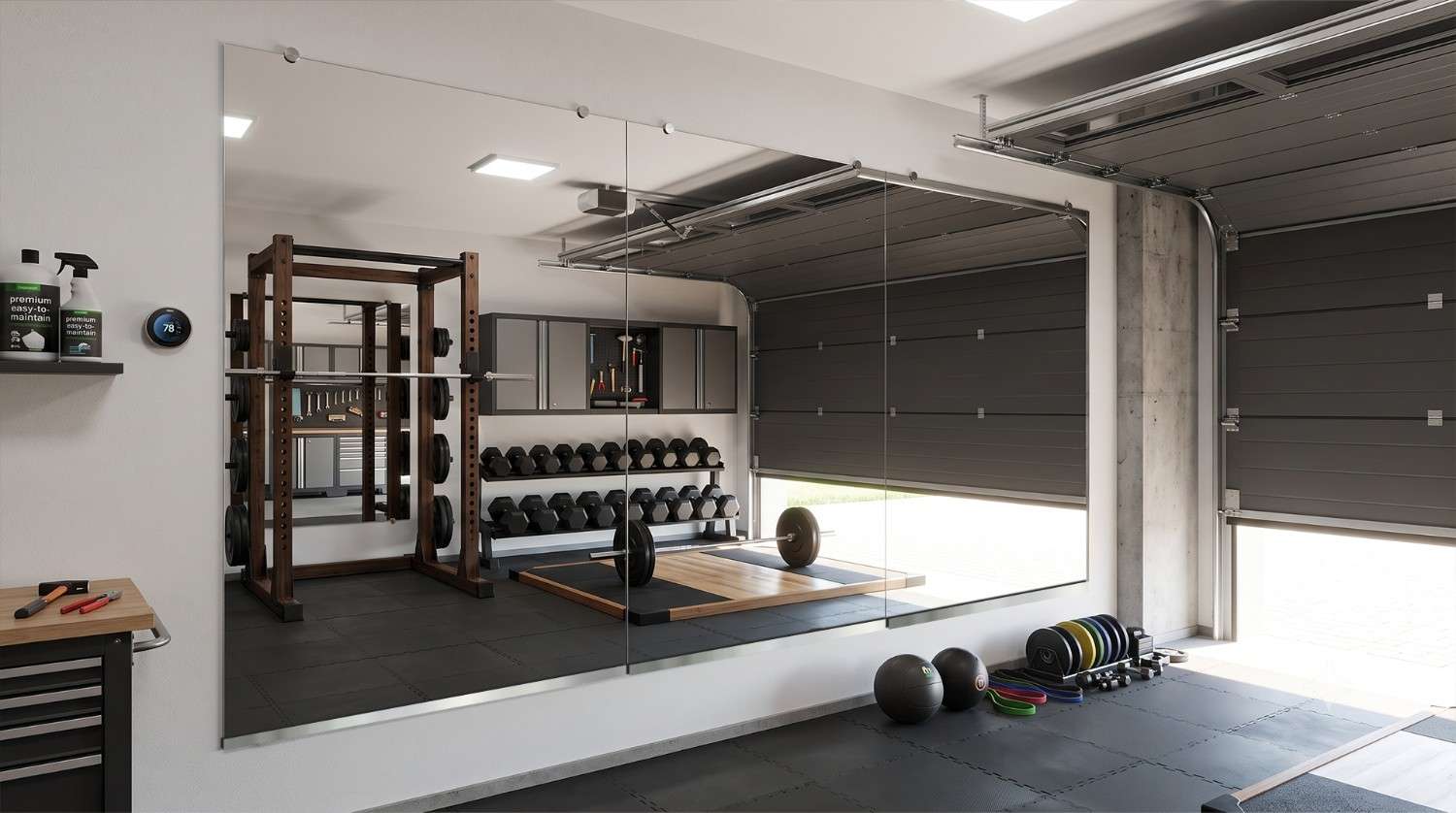
3. Garage Gym Mirrors: Micro-Climate Resilience and Space Flexibility
Garages are brutal environments for standard glass due to exposed concrete, rolling doors, and shifting weather patterns.
Environmental Endurance: Unlike regular mirrors that quickly degrade, rust, or desilver when exposed to garage humidity and temperature swings, specialized garage gym mirrors are built to withstand moisture and thermal expansion.
Dual-Purpose Space Saving: Because garages often double as parking spaces or workshops, gym mirrors allow you to claim the vertical wall space. By mounting the glass flush to the wall, you get a fully functional training zone without losing a single square inch of floor space. (Discover how to map this out in our guide on how to transform your half-garage into a functional gym).
Open-Bay Door Glare Redirection: When training with the garage doors open, direct sunlight can create blinding hot spots or harsh shadows. Strategically angled wall mirrors help catch and diffuse this intense glare, keeping the interior lifting platform evenly shaded.
Porous Wall Dust Protection: Garages are high-dust environments due to cars, tools, and lawn mowers. Unfinished garage drywall or plywood absorbs this grime and is impossible to wash, whereas glass gym mirrors provide a non-porous barrier that is incredibly easy to spray down and wipe clean.
Now that you understand the unique benefits of using a gym mirror tailored to your specific environment, the next steps are determining your spatial constraints and setting your project budget. To ensure you get the absolute highest clarity without the “funhouse distortion” of cheap glass, explore our expert breakdown on the gym mirror vs. regular mirror comparison or dive into our ideal gym mirror size guide to find the perfect fit for your walls. Once you have your dimensions selected, view our comprehensive breakdown of gym mirror installation costs to decide whether to tackle the project as a weekend DIY or hand it over to a professional installer.
FAQs
Commercial and premium residential gym mirrors should be 1/4-inch thick. This thickness provides the structural integrity required to prevent the “funhouse distortion” common in thinner glass, ensuring a perfectly flat, true reflection across large walls.
Safety backing is a protective film applied to the back of the mirror. In high-impact environments like commercial gyms or dojos, if a misplaced weight strikes the glass, the film holds the cracked pieces together instead of letting them shatter across the floor, mitigating injury risks and liability.
It is not recommended. Standard residential mirrors easily degrade, rust, or desilver when exposed to the fluctuating humidity and temperature swings of an uninsulated garage. Dedicated garage gym mirrors feature micro-climate resilience to withstand moisture and thermal expansion.
Because yoga and Pilates practices happen primarily low to the ground on mats or reformers. Extending mirrors entirely to the floor level allows clients to accurately monitor their spinal alignment and core engagement during horizontal movements without having to lift or strain their necks.
Basements can feel claustrophobic and uninviting. Large vertical mirror panels bounce overhead light into dark corners to maximize brightness while creating a powerful optical illusion that makes low basement ceilings feel much higher, turning a “dungeon vibe” into an open training oasis.
Muhammad Bilal
Muhammad Bilal is a senior writer with 17 years of experience, specializing in engaging, well-researched content on glass and mirror products. His writing offers practical tips and insights tailored for homeowners and designers alike. With a clear, approachable style, he helps readers solve problems and explore ideas with confidence.
Related Posts
Explore all things glass—from stylish table tops and insulated options to tinted and frosted designs. Discover guides on glass railings, custom cut glass, shelves, and stunning backsplash ideas for a modern home or office upgrade.