We have an in-stock product at a competitive price with fast delivery.
Quantity Discounts Available
±1/16"
Cutting Tolerance
120"
Max Seamless Panel
478K+
Pieces Cut Since 2011
<1%
Breakage Over 1M Shipments
Cut To Order – Ships Nationwide
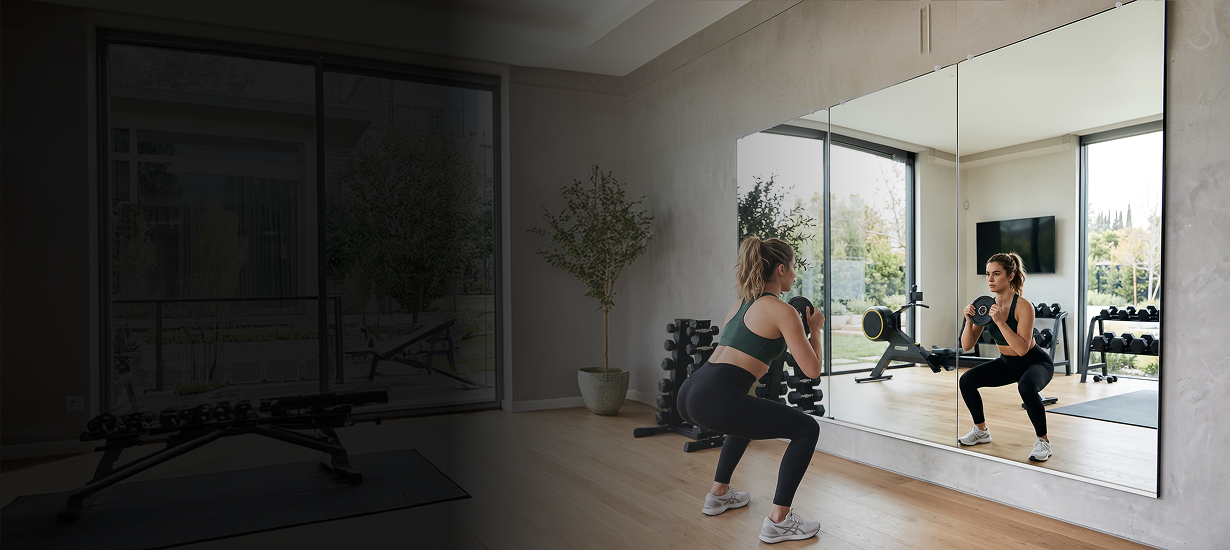
Custom Gym Mirrors, Cut To YourExact Wall Size
Send your measurements at Fab Glass and Mirror down to the inch and we'll cut tempered, safety-backed mirrors to fit, no gaps, no guesswork, no trimming a stock panel on-site.
Short answer: yes, for most sizes. Long answer depends on how big your panel is — so here's the honest version rather than the sales version.
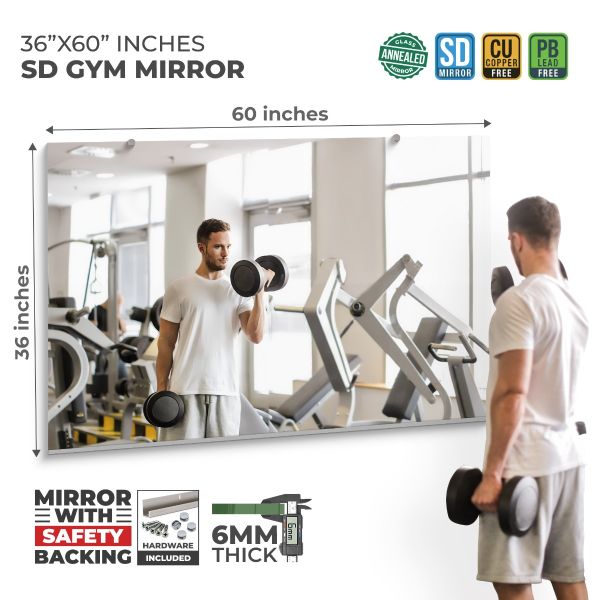
Up to 60 × 36 in
Comfortably DIY
Two people, about an hour, basic tools. The panel is light enough
to handle by hand and the J-channel does the structural work.
You need: stud finder, level, drill, tape measure.
60 to 96 in
DIY With Suction Handles
Still a two-person job, but the panel is now heavy and flexible
enough that carrying it by the edges risks a crack. Suction handles
cost little and change everything.
Add: A pair of suction cup handles, and clear your
route to the wall first.
Up to 60 × 36 in
Consider Help
At this size we'd rather you had a third pair of hands, or a local
installer. A dropped 40 sq ft panel on a tile floor is a bad afternoon.
Or: ask us to split it into matched panels with the
seam placed off your eyeline.
Step By Step
How to install your cut to size gym mirror
This is the same sequence our install video follows. Read it before you order
and you'll know exactly what Saturday looks like.
About 1 Hour · 2 People
Tools You'll Need
Stud Finder
Spirit Or Laser Level
Drill + Bits
Tape Measure And Pencil
Suction Handles (Panels Over 48 In)
Supplied In Your Kit
Cut Mirror Panel
J-Channel Bottom Rail
Clips And Wall Anchors
Positioning Template
1
Find And Mark Your Studs
Run a stud finder across the wall and mark each stud. Your bottom
rail and top clips should fix into studs wherever possible rather
than into drywall alone — a mirror this size is heavier than it looks.
2
Mark Your Mirror Height
Decide where the bottom edge sits. For standing form checks, 24 to
30 inches from the floor suits most people and clears baseboard
trim. Draw a level line across the full width.
3
Fix The Bottom J-Channel
Screw the J-channel along your level line. This rail carries the
entire weight of the panel, so check it is dead level before you
tighten anything.
This Is The Step That Matters
Every other step inherits this line. If the channel is out by
a degree, the panel sits crooked and no amount of clip
adjustment will fix it. Check it twice.
4
Lift The Panel Into The Channel
With your second person, lift the mirror and seat its bottom edge
into the channel. Keep the glass vertical throughout and never let
a single corner take the weight that's how panels crack.
5
Fit The Top And Side Clips
Hold the panel flat to the wall and mark clip positions with the
printed template. Drill, anchor, and fit the clips so they hold the
panel without clamping it. Glass needs a little room to expand.
6
Check The Reflection And Clean
Step back and sight along the surface for any bow. Tighten only
what needs it, then clean with a non-ammonia glass cleaner sprayed
onto the cloth — never onto the mirror, where it can seep to the
backing edge.
Premium Cut to Size Gym Mirrors Perfect Your Form, & Maximize your Space
Experience uncompromised clarity and full-body coverage with our custom, safety-backed mirrors. Designed to provide a flawless view of your alignment from every angle, creating an immersive professional studio at home.
Thickness is the specification most often wrong, and in a gym it matters more than anywhere else — because you are using the mirror to make judgements about your own body position.
Thin glass flexes under its own weight across a long span. A flexed
mirror bends the image — and a bent image lies to you about your knee
tracking and bar path, which is the one thing a gym mirror exists to
get right.
Safety Backing, Not Tempering
The relevant US benchmarks for safety glazing are ANSI Z97.1 and CPSC 16 CFR 1201. Local codes decide when compliance is mandatory, so check with your local building department for commercial gyms and multi-family buildings. For a home gym, you have two routes:
Bonded Safety Backing Film — A polymer layer on the reverse retains fragments if the mirror breaks. Standard on every panel we ship, and it doesn't touch optical quality.
Tempered Mirror — Heat treated to break into blunt pieces. Stronger, but tempering introduces slight surface distortion.
From Our Fabrication Floor
Gym owners regularly ask us for a tempered mirror, assuming stronger must be better. We usually talk them out of it. Tempering warps the reflection just enough to matter when you're checking a bar path — and a bonded safety film delivers the fragment retention they were actually asking for. This is why our gym mirrors are annealed with safety backing rather than tempered.
What Size Mirror For A Home Gym?
Two dimensions to settle: how wide, and how high off the floor.
Single Lifting Station — 48 × 36 in covers your
frame at a squat rack or bench.
Standard Home Gym Wall — 60 × 36 in is our most ordered size home gym mirror and the one most garages end up wanting.
Dance, Yoga, Group Classes — 96 in wide or more, so a
full group stays in frame.
Mounting Height — bottom edge 24 to 30 in from the
floor for standing form checks. Drop to 12 to 18 in if you do a lot
of floor work and want to see it.
Measuring Your Wall
We cut to ±1/16 in, half the ±1/8 in commonly quoted in the trade. That
precision only helps if your measurement is right.
Measure At Three Heights. Walls are rarely square.
Take the width at top, middle and bottom, then use the smallest
figure.
Leave A Deliberate Gap. Going wall-to-wall in an
alcove? Subtract 1/8 in from each dimension so the panel drops in
rather than being forced.
Account For Trim. Decide whether the wall mirror sits above the baseboard or gets scribed around it before you measure.
Work To Eighths. Anything finer isn't meaningful at
these tolerances.
Five Mistakes We See Most
Hanging On Drywall Alone. Find the studs. Drywall
anchors alone will eventually let go of 40 lb of glass.
Skipping The Bottom Rail. The J-channel is structural,
not decorative — clips alone put shear load on the glass edge.
Clamping The Clips Tight. Glass needs room to move.
Snug, not gripped.
Ammonia Cleaner Sprayed On The Mirror. It wicks to the
edge and attacks the silvering. Spray the cloth instead.
Ordering To The Old Mirror's Size. The piece coming
down may have been cut wrong in the first place. Measure the wall.
Is A Glass Gym Mirror Right For You?
Compared With The Alternatives
We'd rather you bought the correct thing than the most expensive thing.
Here's honestly where each option wins.
Yes. Panels up to about 60 × 36 inches are a straightforward two-person job taking around an hour, using the J-channel and clips supplied in the kit. Above roughly 72 inches the panel becomes heavy and awkward enough that suction handles and a third pair of hands are strongly advised. Every kit includes a printed positioning template, mounting hardware and a step-by-step video.
How much does a gym mirror cost?
Custom gym mirrors are priced by square footage, so cost scales with size rather than with whether the dimension is a round number. A 48 × 36 inch panel is around $151, a 60 × 36 inch panel around $189, and a 96 × 60 inch studio wall around $504. Shipping is free and the price shown includes safety backing and mounting hardware.
What size mirror do I need for a home gym?
For a single lifting station, 48 × 36 inches covers your frame at a squat rack. 60 × 36 inches is our most ordered size and suits most home gym walls. For dance, yoga or class formats, aim for 96 inches or wider so a group stays in frame. Mount the bottom edge 24 to 30 inches from the floor for standing form checks.
How thick should a gym mirror be?
One quarter inch is correct for gym mirrors up to about 60 inches on the long side. Beyond that, step up to three eighths of an inch, because thinner glass flexes across a long unsupported span and a flexed mirror distorts the reflection you are relying on to correct your form.
Should a gym mirror be tempered?
No. Tempering introduces slight surface distortion, which defeats the purpose of a mirror used to check lifting form. The correct specification for a gym is annealed mirror glass with a bonded safety film on the reverse, which retains fragments on impact while keeping the reflection optically true.
Can gym mirrors be cut to any size?
We cut to any dimension up to 120 inches on the long side as a single seamless panel, at a tolerance of ±1/16 inch. Walls wider than that are covered with matched multiple panels, with the seams positioned deliberately so they don't cross your eyeliner while lifting.
If your project will allow a 16 week lead time, we can give you a 20% break on the price of your items. The minimum order quantity before the discount must be $7,000.00
 My Shower Projects ()